
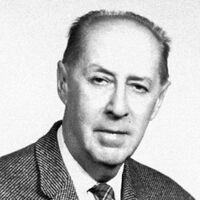
Grosschmid Sándor Károly Henrik (Kassa, 1900. április 11. – San Diego, Kalifornia, 1989. február 21.) magyar író, költő, újságíró.
With my last breath, I thank fate that I was human and that a spark of reason shone in my dim soul. I saw the earth, the sky, the seasons. I have known love, the fragments of reality, desires and disappointments. I lived on the earth and slowly brightened. One day I will die: and how wonderfully right and simple that is! Could anything else, better, greater, have happened to me? It could not. I have lived the most and the greatest, the human destiny. Nothing else or better could have happened to me.
And never forget that you were also the son of the world. A relative of blacks and stars, of reptiles and Leonardo da Vinci, of Gulf Stream and Malay women, of earthquakes and Lao tzu. You had something to do with it all, you were made of the same stuff, you were created by the same soul, you were taken back by the same soul. That's for sure.
No matter who speaks for your homeland. No matter what those who think they are entitled to speak for the homeland say. You listen to your homeland. Always give everything to your fatherland. The world makes no sense to you without your fatherland. Don't expect good from your homeland, and don't complain if you're hurt in the name of your homeland. All this is meaningless. Don't expect anything from your fatherland at all. Give only what is best in your life. That is the supreme command. Villain is one who does not know this commandment.
And the formalities must be adhered to until the last minute. During meals, during conversation. In bed and at the table. And when human coexistence becomes more and more formless: you remain faithful to the established, ultimate and crystalline forms of greeting, bowing, shaking hands, expressing feelings, forming opinions. In an age when everyone demands that you wear a formal dress, you must wear a jacket consistently, and in the evening, if you are invited to company, you must wear black. Not for the dress, but for the form.
Literacy is not saved only by books. Literacy is saved by the little reflexes of common days. When an age comes at you with raised fists, you say hello back, calmly and politely, by raising your hat.
You can't do anything else.
People are usually offended if we are too polite to them. I'm talking about people in Europe and America. Only the Chinese can endure the unconditional, the unmitigated, the fatal politeness that has already permeated the whole fabric of their bodies and souls, one with life, even for the gut-washers and the princes. This courtesy, which is clear in the way of life of the people, is the supreme manifestation of human coexistence. But our politeness is entirely superficial. To the Frenchman, only his literature and his declaration of war are polite: his dining-room, his shop and his salon are not. It is not enough to say "pardon" when you step on someone's foot. You have to feel 'pardon' - and that is much harder. Our age is one of the most impolite ages of mankind. The executioner of the Middle Ages would kneel before the victim and apologise for having to cut off his neck: and Marie Antoinette would say to Sanson on the scaffold: 'Pardon'. But now neither the executioner nor the victim apologise to each other. This is sad. And if one is perfectly polite nowadays, one's contemporaries perceive this attitude as cold, callous indifference. Today, everyone demands a 'fake confession', and politeness is perceived as evasion and betrayal. But it is not: it is simply experience. There is no other solution. When everyone is digging in each other's guts, with passionate love or mad hatred: you remain polite.
It's also amazing how sensitive people are. Like a rose. Like a rock jasmine. They listen so fatefully to every word that might offend their vanity, like no one and nothing in the world of the living. A single utterance can wound a man to death, yea, your very silence, when he expects you to praise or approve him: it turns a man into your enemy for ever. And these same people, who sense everything about themselves with such a fearfully delicate ear, who can sense the intimacy of a handshake or the tone of a telephone conversation, the flash of opinion or truth that flashes towards them, these same people, more gentle and sensitive than a mimosa, follow the most vile vices with a carefree attitude, cruel without blinking, indifferent and sometimes cheerful. This resilience of the human soul is not worth criticising; it is just something to be aware of. And not to be surprised at anything, ever.
Love, proclaim and confess the truth, the small and great truths, the truths of the ordinary days and the fateful moments, always, courageously and without fear. But it doesn't hurt to smile quietly at the same time: at yourself, at the truth.
For truth is constant and unchanging, like the great laws of nature. But you, the man who believes and confesses the truth, are neither constant nor unchanging. Even the weather can change your intentions, even a snowfall can divert you from the path set by divine command, even a woman can affect you: such is your changeableness. What can you hope for yourself?... Proclaim the truth, but it doesn't hurt to smile sometimes.
Sometimes you feel like you're going to die the next moment. You don't necessarily need to call a doctor. Learn not to be afraid and not to hope. Death is not the worst thing that can happen to a mortal, no, death is not "bad" at all: death is nothing. Let us die, if we have to, in a humane way, that is, with dignity and without haste and without fuss.
But let us also live, as long as we can, in a human way, that is to say, attentively, seeking the meaning of phenomena and events, examining their true nature. What can you say to a doctor when you call him at a dangerous moment and he asks you the reason for your illness? Your mind works, so you should know everything that concerns your body. And when you look at yourself in this way, you are suddenly struck by how complicated reality is: every human thing has an infinite number of causes, every aspect that connects us to the universe is the cause of something that will happen at some point in our lives or in our organism, and the main "cause" is myself, the fact of existence. This is the "cause" behind all the phenomena of life. This "cause" can be arbitrarily eliminated, but it cannot be completely dismantled, explained or understood.
All the world can want from you is a bargain and a half-solution. What matters is what you have contracted with yourself and your character. There is no bargain in this contract.
Life takes from a character a more cruel interest than a usurer. You have to pay for everything, for independence, for pleasure, for physical health, but most of all you have to pay for the contract you have made with your character and your work. You can never say to this slave-owner, 'My head hurts.'" Or, "I'm in the mood for something else." It is easier for the slave rowing in a galley than for the one who has contracted his character to work.
For the work that is yours alone, from which you have no escape, no right, which is your destiny: you need not only skill, ability, knowledge, experience, no. For work you need not only suggestion and grace. And it needs not only the diligence of a beast of burden. All is needed, and all is not enough.
It takes divine virtue to work. This virtue is patience. Not to abandon the work. Not to grow fat. Not to run away from it. To bear it patiently, like a mysterious disease, to live with it day by day, for years, for a lifetime, like a prisoner with a jailor, like a sick man with the affliction God has laid on him.
Patience is not man's virtue. If he does undertake and practice it, then, only then, does he sometimes resemble God.
Do you think you have built a house and can look out at the world from the proud towers of your career? Don't you know that you'll always be a wanderer, and that everything you do is the movement of a wanderer on the road? Forever you move between cities, destinations, ages and changes, and if you rest, you rest no more surely nor permanently than the wanderer who rests in the shade of the roadside apple tree for half an hour on the way. Know this when you make plans. The purpose of your journey is not the destination, but the wandering. You live not in situations, but on the road.
There are two ways of sinning against the body: by debauchery or by cowardly, vain and offended asceticism. It can bear neither, and responds defiantly and fatally to both insults. The flesh can only stand honesty.
The greatest tragic temptation of manhood is not woman, but vanity. You want rank, position among men, titles or medals, everything that glitters, that you can hang on your chest in dangling banners, that you can print on your business card in empty and sonorous words. You want an armchair when others are barefoot on the highways and city streets. You want dignity when life for the masses of people is so miserably bleak that most of them lose their dignity. This is the difficult hour in a man's life. Most men fall at this hour. Only those remain men and human beings who can bow down to human misery, who can content themselves with the only rank that man can bear: the rank of work-consciousness and helpfulness, of patient fairness, and reject all that the world can give them in worthless recognition. Think, then, what vile men wear the highest titles and ranks! They flaunt their medals! Stay, untitled and unadorned, man. And then you will indeed have some rank among men. Otherwise, you will be only a dignified or a gracious lord - are you so humble? I thought you would desire more.
Outwardly worn, conspicuously displayed and evidenced religiosity always masks a deep and cowardly greed and sexual hunger.
Does it surprise you that meanness springs out of a man like poison from a toad? But think what kind of man is this? How deformed, how powerless, how hateful and envious is his strength? Wipe away the spittle that is splashed upon thy face, and do not trample the toad, for thou shalt soil thy shoes with blood and pus.
People like to be rude and hateful as soon as they get the chance; and most of the time they are indeed as peculiarly cruel as children. But you remain humble, and at the same time keep your dignity. For you can only keep both at the same time. Your dignity will be a distorted conduct, if it is not backed by the consciousness of the humility of your fallible being; your humble conduct will be the expression of the cowardice of a sissy, if it is not backed by a sense of your human dignity. If you must live among men - and you are neither tapir nor vulture, so where else can you live? -you must rule and obey at the same time, always with dignity and modesty, always with seriousness and readiness, always with humility and dignity. Otherwise you are but a boastful freebooter, a pitiful and cowardly slave. But Epictetus was indeed a slave: yet he bore this fate with humility and ruled over men.
Things are not just in themselves: they have a perspective. Therefore, never say of a phenomenon: "such or so" - only say: "from this and this perspective it looks like this."
Accepting that a human can't help. There is no woman and there is no friend. To accept that maybe you don't need help: this despair, this hopelessness, these momentary solutions, this eternal insolubility of all that is human, is the very condition for remaining human and expressing yourself in the world in a human way.
Whoever you face, know that he is only human, with only one claim to greatness: justice. No matter what he says, what he knows, what is his rank. He has no right to be called a man unless he conquers in himself vanity, lust, pride, and greed, and speaks the truth in your cause and in the cause of the world you are about to speak of. All else may be pleasing or attractive, but you must not be intimidated or tempted.
Worldly dignity is gold smoke and gambling coins; but human dignity is reality, gold. Why play for counterfeit money, when God has filled your pockets with gold?
Every time we encounter injustice or cruelty in life - a child is tortured, an animal is abused, a human being is humiliated or denied what is rightfully his by divine and human law - we are always haunted by the question: is it your right and duty to intervene, to intervene, to take on the ungrateful role of an unwelcome praetor in the turmoil of alien fates? Or go away, with a guilty conscience, but unharmed? Know that you have the right to interfere in the affairs of strangers and the world only so long as you, personally, without the interference of foreign men or authorities, can actually help where you see injustice, unfairness or cruelty. For he who, with justifiable indignation, passes on help to others, "calls" the attention of authority or philanthropists to what he has seen, is already making a "cause" out of human misery, is already taking a part between suffering and help, is already deceiving himself and the world. Be alone with human suffering and try to help to the best of your ability. If you can wipe the tears from a child's face, if you can relieve a sick horse, if you can give money that is yours, or clothes to a ragged man, or advice and action to help something, personally - then, only then, you have the right to intervene. But anyone who calls the police in such situations, or writes letters to the newspapers, or takes up collections for the needy, in short, makes a role out of the misery of others for themselves, is suspect. Your pain and misery are personal, and you can only help in person. Everything else is vanity.
Youth must be bid farewell in good spirits. Therefore, not with emotion or sentimentality, like the weak, the whiny and the ignorant, who, with bowed heads and teary eyes, stare after the departing youth, bid farewell and moan in a voice trembling with self-pitying sentimentality: 'Vale, Youth!... Farewell, happy Youth." This is no way to bid farewell to youth. One must bid farewell to youth with joyful, full-lunged, roaring laughter, as one who is rid of an unreliable companion. It should be said, "Go away, Youth. I watch your departure without pity. It was not so good to be young. It was confusion, fog, longing, disorientation, false notions, even more false concepts, desire and fear of falling behind in the great race. And when we held someone in our arms, how many misunderstandings! And the fear of missing the Other, who is truer! And how different the fame we craved when we were young, How more suspicious and more illusive when it came! And the worldly goods, when they came into our lives, how suspiciously clinging to the filth of human envy! Nay, youth may be parted without regret. It was a state of fever, a touching and tender ecstasy. Now, when you are gone, Youth, I turn with joy to the other landscape. I am me now, from top to bottom. Not good, not wise, not quite fair: but I now suspect something of what is true. My eyes are not so good; but my understanding is sharper. There shall be no disappointments, but surprises." Put it this way: "Thank God, youth is ended."
After all, you need to know what you were doing on the earth. In no way is it to keep a certain amount, texture and quality of bone, meat, fat and viscera in a chemical plant. Neither is it to collect titles, ranks, be president of some society, walk around in fancy clothes and ring the bell. Neither is it - and this hurts more - to be happy, because there is no happiness, because all your desires are distorted at the moment of realization, and are more of a nuisance than a joy. That is man. No, your only business, the only meaning of your existence on earth, is to know the true nature of human and worldly things, the interconnection of human and worldly phenomena, and to behave justly even when your fellow men behave unjustly. That was your business on earth; nothing more.
You have to be very careful of people who are right. For example, they have been struck by great injustice, by a great perfidy: they have robbed the fruits of their labour, their liberty, killed their beloved, and all this has been done unjustly by greedy or mean or cruel men. These men are right, and they walk in the world like a flaming torch, carrying around a red-hot fire of darkness, their undoubted righteousness. And they want compensation, or do they want revenge, and sometimes they themselves don't know exactly. What they want? - if only something should happen... These wretches are very dangerous because they are right; all men are dangerous who are right and knows it.
In practice, coexistence can only be achieved with people who are guilty, people who have put the wrong wood on the fire in one way or another, and they know it. These are the people with whom societies can be run. The offended, and those who are necessarily right, are worse than the people with a single book. Because they have only one truth, and they want the whole world to serve that one truth, the truth of their undeserved suffering. They cannot be approached with intellectual and emotional arguments at all. They must wait until time has sucked the first poison of pain from their souls. Then they will calm down. And one day they will realise that they, the unjustly persecuted and tortured, are responsible for what happened. Everyone is responsible for what happens to them. Then comfort them; not before.
Not even a person of creative spirit and talent has the right to steal some of the time necessary for self-cultivation for creation. It is not so important to write every day; it is more important to read every day. You should always have time to cultivate, every day. Because you may not be of use to your country and to humanity when you create; you need divine grace to do so. But it is certain that you are useful to yourself, to your country and to mankind, if you give time every day to the cultivation of your soul, if you read a passage from a work of exceptional creative minds, if you know a truth or a precise knowledge. It is not important to have many writers in a community, but it is important to have many readers. It's not important that you articulate what is beautiful and true; it's more important that you get to know it.
When you are talking softly to a woman, or bargaining with the powerful, or arguing with the chattering fool, know that death is behind you, listening over your shoulder. His bone face is alert and grinning. For whatever words you use to argue your point, Death knows that in your argument he has the last word. Always remember this when you promise, bargain or argue.
Epictetus recommends that we should avoid going to the theatre altogether. But if we do go, let's be modest and quiet. There are children seating in the theatre. Children, even babies. The iron curtain rises, the spotlight flashes on the red velvet, and in the auditorium at that moment there are a thousand babies with their mouths agape, waiting for a miracle. These babies, just a few minutes before, were in their private lives serious doctors, intelligent lawyers, hard-working and educated teachers, responsible, thoughtful adults. But the moment they sit down in the auditorium of a theatre, and the red velvet of the curtains flashes with the glow of the spotlight, this theatre crowd is a tiny, gap-mouthed crowd in a gigantic nursery. A thousand babies waiting for their pacifier. And when they get the pacifier - sweet or bitter, it doesn't matter - they sit happily and contentedly, silently. But if they don't get the pacifier for five minutes, they start to growl, cough, yawn, fuss, and sometimes protest in a haughty way. What is this pacifier? The tension. So don't be too proud in the theatre if you like something. Say this: "I was a good kid, I got a pacifier."
It's a good idea to know exactly which Sign you were born in. Because there is no doubt that you were born under the stars, so you have a connection to them.
But you just live as one who was born on earth, and will be converted here, to earth. Only greet the stars with a glance, for you cannot know anything about them. You can only know the earth. For you have been earth and will be earth. Know the earth, get used to it.
Love the earth as your destiny, written in the Signs and the stars. Take care of it, settle into it, know it in its materiality, do not be alienated, squeamishly, from the earth. The earth is not dirty. It is as you are: matter with power. The Signs and the stars, that is the secret. No doubt you live among secrets. But more certain, you'll die one day and become earth.
Of course, you should always walk alone, at least one, but preferably one and a half, if possible two hours a day. Walking expresses the most human rhythm of life. A person who walks does not want to get anywhere, because if he sets out with a purpose and a destination, he is no longer walking, he is just moving. The walker has, at every moment, arrived at the destination of the walk, which is never a house or a tree trunk or a beautiful view, but this very airy and direct contact with the world. A person who slowly merges with the landscape, becomes part of a forest or a field, surrenders himself rhythmically to the eternal reality, the timeless worldly space, among the great scenery of nature, feels at every moment that he has returned home while walking. The walk is total solitude. In a room, you are surrounded by books and objects that remind you of the tasks and duties of your life, of your work or vocation. The one who walks is freed from his work, alone with the world, surrendering his soul and body to the primordial elements. Think of walking on the earth and walking under the stars. It is a great thing.
Life - sometimes it feels that way - is almost unbearable. You are living in a moment of turning of fate and turning of the ages, when everything is shaking and changing, traditions, moral laws, known ways of life. It's as if you no longer live in houses, but in the jungle of life, where the sky is always roaring and the storm raging. And you hope for change. You trust that one day all the tempers in hearts will burn to ashes, the soot and bitter smoke that spreads in hearts will dissipate. Sunlight will once again fall on the human landscape. The sea will be blue and the fruit of the trees fragrant. Change brings peace.
Change will come naturally, when the time is right: emotions will be put to rest. But one thing will not change: human nature. No morality, no reasoning, no miracle can truly and profoundly change human nature. Those who bring and live the change will be human again, and therefore unjust, impatient, cruel, greedy and lustful. Modification, change in all things human, will come, but man will not change. All attempts at education have failed so far. Sometimes, a very strong character and individuality, for a short time, forty to fifty years of life, can validate the moral claims of the great human educators in practice. These brief periods are sporadic and rare in the history of the human race. It is the best that man can do. But it is a very rare phenomenon. Man remains what he was. Human matter is hopeless, fire and lye cannot change it.