
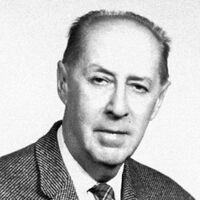
Grosschmid Sándor Károly Henrik (Kassa, 1900. április 11. – San Diego, Kalifornia, 1989. február 21.) magyar író, költő, újságíró.
A liar always talks fast, mincing and babbling. He is very careful to embellish the incidental detail of a lie with every shade of truthfulness. He meticulously describes the clothing of the person he has not met but lies that he has just seen him. He lies desperately, like a good student who blows his homework.
A liar has no real imagination; he lies most of the time without a purpose; he does not know that the simplest reality is more interesting than anything he can conjure up.
It is not at all certain that the Spartans, when they threw the stunted children off the Tarpeian Rock*, did not also throw down strong, powerful souls at the same time as they threw down the stunted bodies. I have always loved stunted children, and have felt not only a natural tenderness for such defenseless, small, pale creatures but also a certain respect and affection. It is by no means certain that the greatest efforts of mankind are accomplished by perfect-bodied wrestlers and flawless gladiators, yes, I think the stunted have a job to do in the world, and perhaps not so last a job to do. I am not, of course, saying that we should breed the vices; I am only saying that we should leave to life what it has planned for us, and believe that the vices may have a job to do in our world. Perhaps they are the very ones whom life has chosen for such mighty tasks that a gladiator would crumble under. The Tarpeian Rock is never the answer. Life knows, better than the Spartans, who to keep for its purposes and who to discard.
* - In ancient Rome, the condemned were thrown down from the cliff of Tarpeia (from the name of the Roman leader Tarpeius). The context refers to the Taygetus Mountains, from where the Spartans threw down weak babies, deemed unfit for life.
Like the sailor whose ship has been caught in a storm, and suddenly he sees the sails tightening, the great sail panels swelling ominously with the hurricane's frenzied breath, the wires creaked and crackled, and on the bobbing and dancing deck, amid the roaring and crashing waves, he staggered, and with his last strength, rushed to the sails and ropes to loosen them all: so you too, in the dangerous and turbulent moments of your life, know that you cannot endure great tensions, human bonds and relationships must be loosened, otherwise everything breaks and tears. At such times, throw everything aside: work, human relations, life order, and leave yourself to fate and the storm. In every life and in every period of life such storms arise, when all that has been bound up until then cannot stand the strain of the storm of passionate passions. Relax and wait. By morning the storm will have passed.
Every word you write, every word you utter, is written and pronounced in such a way that it can stand the test of mundane reality. Perhaps this is the secret of writing and of life. For it is useless to have a word in its place in the literary volume if it cannot withstand the atmospheric pressure of reality in the mundane volume.
Before you judge the extraordinary, throw it into the mill of everyday use and grind it there for a while. Have you met an extraordinarily beautiful woman whose beauty dazzles and amazes you? Observe for a while this extraordinary beauty in the glare of everyday life, and you will suddenly learn that all beauty is hopeless and sad, not worth caring for. Are you dazzled by the extraordinary spirit of a man? Examine what he said in the practice of the commonplace, and you will understand at once that wisdom is not something extraordinary and incomprehensible, but something very simple and natural. Have you met a man of extraordinary power? Just think how fragile this man's power is, on Mondays and Tuesdays - he could be killed by an assassin, a political movement, or even a tiny infectious microbe! Have you encountered extraordinary human goodness? Then marvel and remain in awe. But it doesn't happen to you often.
Whenever the temptation comes and speaks to you, promising friendship, passion, intimacy, a bond, know that the material of which such a bond is made is perishable, because it is human material. What today is an oath, tomorrow is a nuisance; what today is passion and desire, tomorrow is an incomprehensible and distorted memory; what today is loyalty, tomorrow is sad duty. The temptation smiles uselessly, promises, hopes. The desire to share life's loneliness with someone, fully and confidently, lives on in your heart in vain until death. You have no way to do this because you are human. Always know this.
You should know that people cling to mediocrity, to confusion and butterflies, to illusions and half-knowledge, to illiteracy, for a reason. For literacy is the discovery and the bearing of truth - the true knowledge of all things. And to bear the truth is always very difficult. To be educated, that is, to know reality and truth, requires extraordinary courage. Man comes to know the truth with his whole heart, his whole destiny, his whole being. Man can only be educated to life and death. Men are always more ready to submit to a veiled explanation of some inconvenient truth, that is to say, to illiteracy, than to the plain, simple, straightforward truth, which is education. People secretly know that everything that is true and human, and therefore real, is caught in blood, sweat and passion, but they prefer to whisper, with downcast eyes, that children come from the stork. It is more pleasing and more comfortable. But education is not brought by the stork.
See how you can make every day, even the most ordinary, dreary weekday, a celebration, if only for a few moments! With a kind word. With an act of dignity. A polite gesture. It doesn't take much for a human celebration. You can sneak some magical element into every day, give yourself the gift of a quarter of an hour of experiencing the truth of a book, the satisfaction of learning some obscure concept, comforting or enlightening your surroundings. Life will be richer, more festive, and more human if you fill a few minutes of the ordinary with the extraordinary, the human, the benign, and the courteous; in other words, with celebration.
You have a role that is yours alone, and this is your contract with God. But you are also a part of the great structure of the world, not much more, not more important, than a screw or a wire, an auxiliary instrument in some incidental and subordinate process of this infinitely complicated machinery. Never forget your role, which is yours alone and personal, and never forget that you do not count for much more in the Whole than a part, a screw, or a wire.
Of course, it doesn't hurt to have a work plan. Just don't artificially set this plan. Someday, out of anticipation, study, inclination, the order of ordinary days, and the suggestion of extraordinary moments, this work plan will emerge. Never give in to tempting ideas. The idea will flash, and with a certain skill, you can indeed build something from it, something that has form, something that is like a real creation. But it remains an idea, even if you execute it perfectly. Real work, personal and fatal, is different. You have to wait until everything matures and comes to pass to really write or do what you do. At such times, remain relentless and consistent with yourself and your work. But the supreme condition of all intellectual creative work is that state of mind and nerves which Goethe called Schauder*. If you don't have this shudder while you work, you will only create properly and regularly. Without Schauder there is no creation.
* - shuddering, trembling
Being a guest is one of the most delicious and tiring of all captivations. For in vain do the landlords say: 'With us, the guest does what he wants! He wakes and lies down when he wants! He eats what he wants! Of course, the guests and the housekeepers do nothing but look after each other from morning till night, listening to each other's wishes and their way of life, adapting themselves to each other. And yet the householders are freer because they are at home, they impose a kind of established order on the guest, who is forced to behave from morning till night as if he were doing what he wants when he is doing nothing but adapting to the householders. It is particularly rude to invite someone to stay all day or even overnight, for several days, in the countryside. It is an assassination against a free man's tastes, habits, time, pleasures, work, and order. 'Bring nothing but a nightgown and a toothbrush,' say the landlords; and behold, for a day or two you have been banished from your life, deprived of your freedom of action, and sometimes of your freedom of thought.
To be a guest is bondage. It is a great spiritual rudeness and selfishness to invite someone to be your guest. Even to accept an invitation to dinner is a burdensome, tedious, and exhausting duty. It is best to meet friends in restaurants at nine o'clock in the evening and then go home at eleven o'clock, each having paid his own bill. Anything else is assassination and selfishness.
Because there is something more precious than knowledge, more precious than intellect, yes, more precious than goodness. There is a kind of tact that is the height of human achievement. A kind of tenderness that is invisible, colorless, tasteless, and yet indispensable, like boiling water in a pestilent land, without which one dies of thirst or becomes ill. That tact and tenderness which, like some wonderful hearing of music, forever warns a man what is too much and what is too little in human things, what is free and what is too much, what hurts another and what is so good that it makes an enemy if it is given and cannot repay? It is a tact that knows not only the right words and emphasis but also the tenderness of listening. There are rare people who know this. Those who have stewed and ennobled kindness, which is always selfishness, and who never hurt by their friendship or sympathy, are not burdensome in their advances, never say a word more than the other can bear, and, as if they had separate, very delicate hearing-organs, sniff out what it is that can hurt the other? And they can always talk of other things. And they hear everything that is dangerous among people as keenly as electric listening ears detect invisible enemy birds approaching in the clouds at high altitudes. Tact and tenderness are perceived with superhuman perception. Yes, these two faculties are superhuman.
It is advisable to make conscious changes not only to life situations but also to life patterns. Sometimes even a trivial journey, a few kilometers' change of location, can take us out of the familiar, sometimes agonizing and unbearable, inertia of our lives. Sometimes, all it takes is a trip to Esztergom to change our thoughts about life and to see our tasks more clearly. Travel changes your ideas, the French say. The different rooms where we lay our heads to sleep, the strange faces, the changed cuisine, all this triggers a process of reconciliation and refreshment in our souls.
And so we must change the rhythm of our lives today. Not violently. Not clumsily. But consciously, instinctively, when we feel we have stalled in a way of life. Those who have been stubbornly waking up at dawn should arrange their sleep and wake rhythms so that they wake up before noon for a while. Those who have been going to bed early and feel their lives have reached a dead end, go to bed after midnight. Those who have done their most important work in the morning should, if they can, try to change the rhythm of their work to the afternoon. If you are tired in the evening, rest during the day and work at night. If you have had a nap after lunch, sleep for half an hour before lunch. Just don't get bogged down in life's situations, just don't pull on slippers and let your beard down, and always make sure that the creative forces of the world find you in constant readiness and anticipation! It doesn't take much. It is the art of the careful interplay of hearing, heart, attention, instinct, and intellect.
Because people are completely unpredictable. Even if you've known a person for thirty years, you can't predict how they will behave in success or adversity. You know nothing of a man's character, his everyday habits, his intellect, his heart, his reflexes - he remains wonderful and mysterious, even if he is otherwise half-mad. He may answer calamity with a shriek and a shout of joy; success sometimes breaks him, depresses him. Sometimes, on quite inexplicable occasions, people may become angry; for example, they may have endured grief, humiliation, material, physical, or moral misfortune, but then in a moment they may murder, or thunder and howl because the tram does not come on time, or their shoes are tight. Well-balanced, temperate people respond in a very particular way to some roadside remark: as if you had touched a secret wound in their being. Some people can't bear the ringing of the telephone, others ask for a kadarka before they are led to the gallows. The animal, the stone, and the plant are more regular and more predictable, and the storm and the earthquake more reliable than a human. People are wonderful.
I could never imagine God, probably because he is not human and earthly, but divine. Man, when he imagines and expresses God in image or statue, always imagines and expresses some bearded forefather, a sort of chieftain, with a lot of hair, in a peplum, with a woolly beard, like a rabbi or a French schoolmaster. This is how the Greeks and Romans depicted Zeus and Jupiter, and how Christianity depicts the Father. This representation has always confused me and filled me with shame. Such a man-like God, with a beard with a hollowed beard and a nose which he obviously blows out from time to time, could not be felt to be a true God. Of all the representations of the Father, Son, and Holy Spirit, only the idea of the Holy Spirit struck me as worthy of God. God created and administers the world, and therefore the world is certainly like Him - but God cannot be human, otherwise He would have to go to a barber. This simplemindedness has always annoyed me. My God has no beard, no peplum. He is behind all things as Power and Reason. God for me is the Intent that permeates the world. This Intent is conscious. That is why I can speak to it, without false ideas, as the minute intellect speaks to the ultimate, the Reason with capital letters.
For a human creation to be a masterpiece, to dazzle and delight people with its timeless brilliance, something more is needed besides talent, subject matter, and perfection of execution. The masterpiece has an element of the fairy, which shines through with its wonderful light, as tenderly and as startlingly as the northern lights shine in the summer night, unreal and yet luminous, because you can see and read alongside it. Let the masterpiece be real, accurate, clever, purposeful, proportionate, carefully crafted, and faithfully executed - and let it be something more. It must also be beautiful. And with all the self-consciousness, it should be joyful. It should be built according to engineering rules, but it should also have chaos, a coffee spoon's worth of the primordial mist that dusts the constellations with golden grains. Without a fairy, there are only "great" or "perfect" works. A true masterpiece is sometimes not so perfect. It just shines, it has the "just dream" in it, the starlight, the fairy. And this is the part of the task when the artist can no longer help his work; the final brushstroke, the fairy, is done by God.
Human material is poisonous and should only be consumed with the utmost care and caution. It is the human matter that lives in the souls of men; that is the stuff of their souls; that is the intangible and yet real matter that causes them to be neither trees nor animals, but men. This matter is like poison. It is a noxious matter. Man is not a harmless creature, but a dangerous one, like cyanide or the fly agaric. Man only does not poison his fellow man with the substance of his soul if he has no way of doing so or if the experiment is dangerous to him or difficult. But as soon as he has the means to do so - without interest, without purpose, without profit - he immediately believes his poison in the world. Human matter is so poisonous that only the smallest doses can be tolerated without mortal danger. It can only be neutralized to some extent by reason, by intellect, and by the consciousness of hopelessness. Because man is hopeless, he cannot be educated to his true duties, he cannot be neutralized by the ancient poison in his soul. Man is the danger of the world.
The writer should not expect anything from the world. All that the world can give - money, wealth, recognition, medals, social honors - will reflect on his work, his spiritual balance, and the moral strength of his work. The writer should not aspire to be a social authority; he loses precisely as much of the moral weight of his work as he rises in social esteem. The writer cannot have any title or rank; he can have only one title and rank, his name. And his only possession in the world is his work. And let him not accumulate money, nor movable or immovable valuables; let him so organize his life that he may be freer in his work, that he may not have to write a single line which he does not feel like writing, and that he may accept only such payment as he may, in his best faith, and without compromise, or regard to social or fashionable considerations, consider the value of his written work. And let him not care whether he "likes" or not what he writes - and let him not care what becomes of his work in life and the afterlife. Let the writer remain poor. And if gold is sometimes thrown at him with a shovel, let him have the strength to turn away from success. And if he is greedily marked with a medal by a hand, let him one-handed refuse the intruders. Never politicize; always judge; and of course, judge yourself first and most severely. Otherwise, you have no right to call yourself a writer.
Know, know with all your heart and mind, that in moments of crisis, there is no one you can count on. No relative, no friend, no dear one you know; in the big moment everyone throws off their mask, shows their raw selfishness, and you are left alone when you most need someone to stand by your side and offer a kind word, a look of encouragement. You expect no more from anyone, but in danger, you don't get that either.
Live meekly and patiently among people, but trust no one to help you. Train yourself to be lonely and strong. Know that no one will ever help you. And don't complain about it. You are human, so you cannot expect anything from people, and that is natural.
You have to learn to listen, and that is perhaps the hardest thing. You always speak more than one word. You can't listen enough. Also because all speech is hopeless. Even the written and recorded word is hopeless! Look around the world: what good have all those written words, advice, and persuasive experiments done? It has done nothing. What can you hope to gain by telling someone something? You can't hope for anything. Therefore, listen, always listen more and more consistently than you speak, do not try to convince others artificially, because that is impossible - truth has some educative power only if you discover it yourself - and do not try to show off that you know something. I say again, be silent. In peace and in war, be silent. And if you have spoken, rinse your mouth afterward. And when you have spoken wrongly, and are tormented with guilt, do not let that guilt go; face it, face it hard; say, "I have spoken again, and have spoken wrongly, too much, too vehemently, or too vainly; it is done, I cannot help it; but in the future I will be harder and will keep silent." Be silent, for God is silent, and he knows. Why? It is wisest to be silent.
In times like ours, when everything happens not only horizontally but also vertically, one does the right thing if one learns to act with the caution of a front-line soldier. For to be clever, not petty, but calculating in one's movements, to be concerned with space, situation, danger, to act in the direction of least resistance, to be untimely in one's attack, but courageous and calm at the moment of attack, is to be clear in courage. To be a soldier in battle is a dangerous task, but to be a citizen in an era of total, vertical assaults of life is no less dangerous. And we live in such an era. Let us therefore calculate our movements, day and night, at every possible opportunity, so that in the great struggle which has marked us out as warriors, we do not waste our strength in vain. Night and day we must fight. Our work, our entertainment, our reading, our concepts of life, our knowledge and experience, all these are weapons in this struggle. So let us take our place in the humble and dangerous cover, in the den of our lives, watching the enemy's every move, and not wasting our energies or ammunition prematurely. And meanwhile, if the sky is starry and the enemy is asleep, let us look at the stars.
I have never understood men who can pine and moan for a woman. They say, "What is she doing now? Does she love someone else?" Or, "Why isn't she with me?" Or, "How long will I have her?" These feelings are unknown to me in their true, tragic significance, at least they are unknown to me now, I cannot say, of course, that I did not go through such pathological crises when I was younger. But now I cannot understand how someone can commit suicide because of a woman's infidelity or coldness. I lived with women as I passed puberty, during my male years, as dear and necessary companions, who at times, in the great tasks of life, also allied themselves with me in enduring a very difficult fate, the human condition. But otherwise, I expected no loyalty from them, no particular kindness, no sacrifice. I rejoiced in their tenderness, the thrilling and soothing intoxication of their bodies, their quick wits, their instinctive and sometimes heroic impulses, and I overlooked their tenacious and meticulous skill in recording, with a childish madness, human emotions. But when they left my room or my life, I thought no more of them. Such is my nature, and I think that only such conduct is worthy of a man, and I am grateful to my fate for blessing me with such a nature.
After the age of forty, it is advisable to smoke cigarettes through a smoke filter. These mineral-filled smoke filters absorb only a small fraction of nicotine and the combustion products of cigarette paper, but they do help somewhat. They don't prevent nicotine poisoning, but they do relieve morning coughs and slimy hoarseness. I recommend them to everyone.
One satisfaction, yes, one fulfillment in life: to do the quiet, menial, but skilfully done work to which your inclination and ability have assigned you, not to escape from it into vain "roles", to be content with the satisfaction that your work was accurate to the point of possibility, and perhaps useful to people. That is the best that life can give.
The mass, as a social force, has become so powerful in my time that there is no cave, no attitude, no perspective where we can still retreat from it. Of course, it is unwise and foolish whoever is offended by the fact of the crowd and takes refuge in the whining attitude of some squeamish and querulous individualism. The crowd is here, like the rain, the wind, the earth. It must be reckoned with. But Aristotle says: "The great multitude shows quite a slave mentality, and follows the way of life of brutes." Two and a half thousand years ago this statement was made; it is more valid today than ever.
Human vulgarity in our time has reached such hopeless proportions that there is no longer any pedagogical method that can effectively combat it. The reflexes of the masses are no longer human in the sense in which we have come to know the human in the sense of Christian culture and classical education. You can't argue with them; it's like arguing with drunkards or lunatics who only stammer their obsessions in response. Their emotions cannot be influenced; they feel differently from humans. Compassion and sympathy are distorted in their souls; greed and bloodthirst reign in their nerves, the sad lust of unbridled and greedy frothing pleasure: human vulgarity has no limit anymore. All the more reason for every human being to remain stubbornly and courageously in his place, to think and feel as a human being should.
During the air raid, I learned that the feeling of fear that struck me in the first fifteen minutes of the near explosion of the bombs was far more humiliating and inhuman than it was worth giving our souls and nerves to. I have therefore taught myself - which is, by the way, the only true meaning of all our intentions and thoughts - that we must fear nothing, for he who fears in the moment of danger has learned, read, and thought in vain before, in the peaceful period of life, and has filtered in vain experience of the value of human life and the naturalness of death. He who fears deceives: he has deceived himself all his life because he has not prepared himself truly, with a strong spirit, for death. I have therefore educated myself never to fear anything that may threaten me from man or nature; I fear only what I may sin against myself; I fear the word of my conscience; for our actions follow us.
Nicotine is one of the greatest gifts and greatest scourges of modern life: invented by the devil to combat boredom, and there is nothing man can do about it as long as boredom is in the land. It is a strong blood vessel poison, and it makes you dumb. Every time I smoked too many cigarettes in a day to work, the next day I was half-mad and couldn't work. It can also cause anxiety, sweating, palpitations, and other life-threatening complications in our lives. There is nothing you can do about it. Tobacco smoke casts a kind of beneficial haze over the world; it is the common intoxication of the moment, this bitter happiness and forgetfulness - who is strong enough to give it up, or to give it up a moment before it is absolutely necessary? Because one day it is necessary... The heart, the optic nerves, the stomach, the bowels, all rebel against it. Then we throw away the bitter pill, we immediately grow fat, healthy, obese, and unhappy. But until then! As if we were sucking some evil yet blissful ancestral mother's bitter teat all day long! And there must be some play and some poison to live; otherwise, it is only health and exercise, not life.
It is surely no coincidence that the most effective weapon of the Second World War was the airplane - the weapon that attacks vertically. Because all of humanity's wars to date have occurred and been fought in a horizontal line. This war was preceded by the crisis known as the "vertical invasion of the masses" - the masses did not advance horizontally in the fields of a culture, but attacked a form of life vertically within the framework of a culture. It is natural that this attack, this vertical invasion, when it was transformed into war, should have sought the vertical weapon of its nature, the bomb, and the airplane. Great human changes of direction are always followed by changes in the style and direction of the accessories.
It is not worth picking up a pen, it is not worth putting a drop of ink to paper, it is not worth wasting a quarter of an hour of your life writing something that will please the masses and the semi-literate, that will make them exclaim, "Oh! Yes! We thought so too!..." - for which you will be awarded a medal by the official world, paid a lot of money by some literary establishment, and with the money you can build a nice house, which you can then fill with rare objects and noble furniture! Because what pleases them, the masses, is always a misunderstanding on their part, or a betrayal on your part. Gold smoke, a child's plaything, is what is a medal. And all the money thou canst get for work that pleases the world, the fine house thou canst build with that money, all this is but mist, the breath of the world's powers will one day blow it away. Take no heed but the voice of the angel that cries to you when he calls you to your work.
Whenever you can - but never by stealing time from your work and acting in haste with a guilty conscience! - go to one of the thermal public baths, two or three times a week. Bathing is a very old human custom, and it not only exercises and refreshes the body, but also the soul. Bathe slowly, according to your body's laws, with deliberation and patience. The thermal waters will infuse your body and invigorate your soul, soothing your nerves, which are overwhelmed by work and the world. Spas are a kind of wet monastery where you can surrender your body and soul undisturbed to sober and equitable rest. The sulfurous, iron waters act through the pores of the skin on the internal organs and our nervous system; the atmosphere of the spa, the veil of humidity, frees us from the cheap images of the outside world. So bathe regularly and methodically, like the Romans.
Never mind if this habit of yours is despised by the Spartans; remember that Sparta did not give the world a single independent thinker, and was eventually destroyed anyway. Bathe yourself with a clear conscience. Bathe methodically, alternating hot and lukewarm and then cold pools and showers, surrender your body to the dexterity of the masseurs, sit for long periods in the warm water, tolerate having your skull rolled up in a cold-water turban, surrender your body and soul to the calm of the warm water, the lukewarm silence, think, learn aquatic patience, relax. You can't relax in the lap of the houris like you can in a thermal spa pool. And in the hot air-heated chamber, never stay more than two or three minutes. And tip the staff well. And know that you're mortal, but you owe your body something. For instance, spa, twice a week; three times a week at the most.