
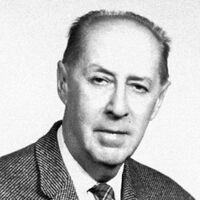
Grosschmid Sándor Károly Henrik (Kassa, 1900. április 11. – San Diego, Kalifornia, 1989. február 21.) magyar író, költő, újságíró.
Tired of living? Yes, one day you will feel you have taken on too great a task when you were born to be human on this earth. There was too much opposition, too much unpredictability, too much hostility, too much meanness, too much hopelessness, too much task, too much suffering, too much disappointment. But don't you think, don't you feel, that it was this hopelessness, this " too", this "much" that gave your life meaning and dignity? Don't you feel that you had a task, a personal task? Don't you feel that nature, which so senselessly exaggerates and wastes, has honored you by creating you as a human being and by imposing your task on earth on a human scale? What can you be but weary? That was your job: to live and be exhausted.
The extent of human meanness is so unlimited, its heat so burning, its ingenuity so original and varied, its formulae of expression so surprising, that sometimes we are stunned and feel that it is the greatest human power. But later on we find that whenever human meanness comes to the fore, human help comes at once. Most of the time, the will to help is more helpless than the will to be mean, more timid, more hesitant. The power of help is more difficult to organize. But it comes, without being asked or called upon, sometimes very bashfully, and at the same time you must see that, against meanness, the human will also organizes help. Sometimes too late. Sometimes imperfectly. But ultimately triumphant. This is my experience.
What can frighten you when your soul is calm? If you overcome vanity, lust and greed? What powers can torment you if you do not torment yourself? What is prison if your soul is free? What is death, if you have known the world and your soul, and do not long for superfluous and embarrassing details? Truly, you were like the child who is unhappy because he did not get this or that. Think always of this: "I have neither power nor wealth, perhaps not even health. But how mighty I am, how rich, how superior, for I have adjusted my desires to the truth and reality of things, and my soul is free!" No one can take this from you, no one can give more than this.
You should not travel alone. A lone traveler is a forced laborer. You should only travel in intimate and courteous company. The company of a sensitive and receptive soul, an attentive and patient friend, multiplies the experience of traveling, enhances the colorfulness of the sights, and helps you to understand all that the journey and the world have to offer. Travelling alone can feel awkward, and uncomfortable. It's like being at the mercy of a strange prison as big as the world.
One can only see and perceive the world in a company. It's the company that gives human meaning to the somber magic of the journey, the change. During my years of wandering, I traveled a lot alone, with little luggage, always feverish, restless, chasing something. I missed a wise companion to stand beside me in the dangerous and unsettling experience of the world, to warn him, to alert me, to share the grim loneliness of the inns, the evil neurosis of the railways. In the company of the right person you can travel around the world and it will seem like a moment. Alone, you'll trudge across the world, by express train and plane.
In human trials, to obtain acquittals whenever possible. Only not if you find the accused guilty of the crime of treason, slowly and coldly planned.
Forgive the murderer sooner than the traitor. The murderer most often acts in a fit of passion and pays for it with his whole fate. The murderer and the victim are most often bound together by some deep and incomprehensible law. The killer most often goes to the gallows. But the betrayer holds your hand, the betrayer looks you in the eye, questions your plans, sighs with you, moans with you, vows with you. Never forgive the traitor. Never show mercy to the traitor. Once betrayed - man or woman, it makes no difference - there is no more test, no more excuse, no more absolution. Banish him from your life. Look upon his fate without compassion. In community and in private life he is the last man, no excuse for him.
In the Middle Ages, there was a mistaken belief that doctors brought diseases to certain regions as part of their trade. Montesquieu overturned this misconception centuries later. Doctors do not bring diseases, diseases bring doctors. And indeed we see that every region has a different doctor. The remedy that has enthusiastic and clever adherents in Paris does not cure in Constantinople. The remedy that is sure to work in Oslo is not so sure to work in Marseilles or Budapest. The doctor who has revived thousands of patients in London is helpless in Baghdad if he is fated to be there. Man is sick and he heals not only according to his nature and habits but according to the cardinal points of the compass. What is a laxative in Helsingfors constipates in Khartoum, and a vascular spasm that dissolves surely in Budapest on a pyramidon remains a vascular spasm in China, no matter how many pyramidons the mandarin takes. Quinine is swallowed by the half-gram in Budapest, and by the teaspoon in Sumatra. One is sick or healthy under a wide variety of conditions. Think about that when you scold the doctor.
The burning question of all ancient philosophy was: 'What is in man's power?'" And they all answered in unison, "Only his soul."
This is the oldest, nay, the only truth that man's intellect has known and accepted as unquestionably true. Time, experience, perception, and contemplation have not changed this truth. Only our souls have power over us, nothing else. But this power is unlimited. No one can violate, no one can take away from us the power exercised over our souls, no tyrant, no social system, no natural law can prevent us from being free in our souls. This freedom is indispensable. And compared to this freedom, all other freedoms that society, power, and money can give us are fragmentary and relative.
Judge your own case as fairly as you educate yourself to judge others. You have no right to be intolerant, unworthy, or over-demanding of yourself. If you want the world to recognize your human rank, recognize your own rank. Act accordingly, with patience and generosity. Demand no more of yourself, no different, no worse, than what you deem fair to others. One cannot be necessarily demanding of oneself. Strive to be more modest, knowing that your powers are mournfully finite. In work, in ambition, in human need, you should feel sorry for yourself, not just for others. It is not enough to pity people; pity yourself. You are a man: and it is so easy to forget that in the worldly race. It is not only others who forget; most of the time you forget yourself.
I have experienced that there is order at the bottom of human life. And since human life is the most complex manifestation of Creation, there is likely order elsewhere, in the more primitive and simple world of existence, like rocks, raccoons, reptiles, and planetary stars. There is order in everything, things come to us even if we do not lift a finger, and there is order in the fact that we occasionally lift a finger or our soul to make things come to us, to make us come to certain situations, people, thoughts, with which we are personally, inevitably involved. There is order in all this, I believe.
But I also believe that there is an intention behind this order that I do not know. Call it what you will. I call it Providence. This intention cares for me personally, punishes me, guides me, arranges my affairs, pushes me into the abyss, controls me at every moment, builds the world around me builds me in the world, and uses me. He who does not perceive this in time is blind and deaf. Behind everything is Providence: this too I believe.
Read with strength. Sometimes read with more power than the force of the writing you are reading was produced with. Read with reverence, passion, attention, and unrelenting. The writer may babble, but you read tersely. Listening to every word, one after another, back and forth in the book, seeing the clues that lead you into the thick of it, listening for the secret signs that the writer may have failed to detect as he moved forward in the mass of his work. Never to be read with a puffed-up, casual eye, as one invited to a divine feast, and only to rummage in the food with the tip of his fork. Read elegantly, generously. Read it as if you were reading the last book in the mortuary that the jailer put in your cell. Read for life and death, for that is the greatest, the human gift. Consider that only man reads.
Whenever I have been attacked and chased - and in the course of a writer's career these chases inevitably recur, sometimes with life-threatening twists and turns - I have found that the writer under attack cannot be protected by any outside help. Not by the powers that be, not by the courts, not by the help of his peers, not even by the voluntary encouragement of well-meaning people and the wisdom of the experienced. The writer is protected only by his works. It is not even the quality of his works, which is always uneven, but the intention that shines through the work of a writer's life. It is this mysterious radiance and power that gives the writer a kind of - relative - inviolability. A writer can only fail if it can be proved that the intention of his work is not sincere. Then the writer and his work commit hara-kiri. Everything else counts for little: neither the accusation nor the defense.
Only your conscience can be your judge, executioner, or protector, no one else! If you write, you are accountable only to conscience, no one else. It doesn't matter what they expect of you, it doesn't matter what they punish you with, if you don't give them what they hope to hear or what they want to hear! Prison and disgrace, pillory and persecution, false accusation and swallowing humiliation, poverty, and misery, all these do not concern you. Only your conscience can punish you, only this secret voice can say, "You have sinned." Or: "All right." The rest is fog, smoke, nothing.
The man who, in armor and a manner befitting the rank of man, wishes to stand his ground in the cruel battle of life, does well if he educates himself not only to impartiality and unquestioning justice but to pride without fear, to contempt of all human treachery and danger, to a superior outlook on all human situations. By superiority I do not mean a timid indifference, but the coolness of a man of reason and character in the face of all the assaults of life. Human meanness, misery, the tangle of accidents and tragedies, the contingencies that lurk around us at every moment to overthrow what we have built up in ourselves or the world by the means of our art, to disturb the tranquillity of our souls, to contaminate the relative contentment of our lives, to rob us of what we have rightly acquired: all this cannot be looked at from above, with sufficient indifference, coldness, and superiority.
We have no right to remain cold and superior only when we see innocent people being abused and tortured. At such times, man, do not attempt, from the pinnacles of some outlook, philosophy, or attitude, to look on human misery with motionless coldness. In your case, remain distinguished, cold, callous, and haughty. In the affliction of others, feel, fervent, act - do not shrink from being a burden to the powerful, beg, bribe, if need be, do what you can to help. In the cause of others, you cannot be impartially and coldly wise, nor proud, nor arrogant. The pain and humiliation of the innocent oblige you to leave the cliffs of your rest. Then, only then, you have no right to remain lonely and proud. Remember this well.
Can we teach someone patriotism? It's like saying, "I'm going to make you love yourself with a whip and a spiked whip." Homeland is not just land and mountains, dead heroes, mother tongue, bones of our ancestors in the graveyards, bread, and landscape. Home is you, flesh and bone, in your physical and spiritual being; it gives birth to you, it buries you, and it is lived and expressed in all the miserable, magnificent, blazing, and dull moments that make up your life. And your life is also a moment in the life of your country.
I cannot teach you patriotism: is mad who denies himself. Your country is a personality magnified and timeless in historical proportions. The homeland is destiny, even in person. Whether you "love" it or not is irrelevant. You are one. But I see and experience that you - verbally, solemnly, in writing, and on podiums - prefer to testify and profess your love of the state. You cannot expect anything from your country. The country does not give you a medal, a job, or a loaf of bread. The country is just that. But the State gives you a fine shallum, a fine dowry for your saloon coat, fine appeasing, if you serve it well, if you go about it with incense, if you confess to the world, with manly, puffed-out breast, that you love the State, even if you'll be wheeled. They don't usually break you on the execution wheel for that. That is why all love of the state is suspect. He who loves the state loves an interest. He who loves country loves a destiny. Think of that when you're thundering on the podiums and beating your chest.
Thanks to the women.
Thanks to you who gave birth to me. And to you who were my wife. And to you, third, tenth, thousandth, who gave me a smile, a caress, a warm glance, on the street, in passing, comforted me when I was lonely, carried me away when I feared death. Thank you for being blonde. And to you for being white. And to you, for your hands were beautiful. And you for being stupid and good. And for you, because you were smart and cheerful. And for you, because you were patient and generous. And for you, because you covered my face with your hair when I was down and wanted to hide from the world, and for you, because your body gave warmth to my body when I was cold in the loneliness of life. And to you, for you bore me a child. And you, for you will hold my eyes with soft fingers. And to you, for you gave me bread and wine when I was hungry and thirsty. And for you, because your body radiated pleasure. And thanks to you for being good like animals. And to you, because your body smelled like the earth at the beginning of life. Thanks to women, thanks.
There are the indifferents, the friends, the opponents, who fight against you at the behest of an idea or belief or interest. That is the order of human life, that is the only way to have a nice tension in life: between friends and opponents, between a great mass of indifference.
And then there is the enemy. He is not an adversary, he is more than that. It is as if destiny had appointed you two to a duel without reason or sense. You know of him, as he knows of you, though you have not crossed his path in any sphere of life or career. He hates you, seeks your bread, your life: you have never sinned against him. For a lifetime you avoid and seek each other.
What can you do against it? First of all, try to understand. He is the counterweight in your life. Otherwise, your life's struggle would be a muddy and unhappy one. You need him. You must overcome yourself to defeat him. You must know the truth to be right with him. You must be better, for he thinks you evil and proclaims you evil. God has appointed him to be your partner on earth. You have a common enterprise, as champions. Do not stab him prematurely; do not stab him at all. he teaches you to live, to fight, to defend yourself. Know that you need him.
To live more, much more, with grass, plants, and fruit. Less, much less fatty and black meat! Eat plenty of fish and rye bread every day. Never drink during the day, no spirits of any kind, and if you do drink, only in the evening, only after meals, only pure wine, never at any other time, and nothing else. If you have drunk wine in one day, do not touch the wine glass for twenty-four hours afterward. To hear the rush of your blood, when with sincere desire it wants to mingle with the rhythm of another body's blood. To turn away from all casual temptation. To know when you want something, you, your body, your taste, your temper, and when you are hungry or thirsty or sensually curious out of gluttony, vanity, or boredom.
To live according to the real needs of your body and the measure of your character.
Any reading that teaches a position and attitude toward death has a humiliating and discouraging aftertaste. All these "ars beatae moriendi"*, the pagan sages of antiquity, the Christian sages of the Middle Ages, the Stoics, the religious, the humanists, and the naturalists of modern times, all try to convince us that death is not to be feared at all. Some offer as a defense and conduct pride and sublime dignity, others wise meekness and acquiescence, others indifference, some enthusiasm, longing, as if death were some supreme good, the ticket to an afterlife which we cannot be too eager to redeem. So speaks Seneca when he teaches indifference because he shows us how nothing, fallible and unremarkable is all that we leave in life; so Boetius, the Christian; so Huxley, the naturalist, when he sees life and death as two versions of a kind of chemical process. Every wise man strives to take some human stand against the horror of death.
This effort is human, and touching. That is why it is hopeless. Think of the wise men dying. And they say in vain: "death is but a change" - they cannot soothe our hearts, nor their hearts before them, with this wisdom. Their minds may know this truth; their hearts remain restless. Seneca died a prisoner. Do not be afraid to die. Do not be ashamed to confess that it pains you to leave this hideous and great certainty, life, for the unknown and sinisterly incomprehensible uncertainty that is death, cessation, nothingness. Be afraid, by all means. Don't complain, but be afraid. Otherwise, if it lightens your soul, you can complain. Don't want to die "with dignity", meaning as a liar. Die as you have lived: like a man, and therefore somewhat heroically, and also cowardly.
* - the science (art) of a happy (good) death - latin
When you stand face to face with the powerful, always think about who gave these people their power? And what can they do against you? Can they take your goods, your freedom, or your life? And then what? A tiny microbe, a contagious bacterium, can take your life, as fragile and ephemeral as the life of an insect. Nay, even the mightiest lord has no real power over your soul and is therefore powerless if you are just and he is unjust. He can do nothing against thee but find thee in sin, and he is just. Think not, therefore, what you will say to the great lord, how you will behave; think only that you are free as long as you are righteous, and the great lord is powerless against your righteousness.
If you are defending a good cause, what is there to be afraid of? What could happen to you? Get beaten down, slandered, robbed, desecrated? Accusations against you, wrongful convictions? All this does not change the fact that the cause you defended was good, and therefore what you did in defending the good cause was good. In such a case, care for no one and nothing but the righteousness of the reason which you have to defend. After all, they are powerless against the truth. They can beat you, but they cannot convince you; they can accuse you, but they cannot lie to you; they can take your life, but they cannot take your justice. You are not alone only if you defend a good cause. There is no pay or reward in such a trial. But there's no deal either. So never be afraid to say what you know with all your soul to be true.
Always change the rhythm of life. To consciously and mindfully alternate work and rest, fasting and abundance, sobriety and intoxication, yes, even care and joy; to consciously rise from the set table of life when abundance is at its best, to consciously engage in cares and tasks that have an educative power. Not to be discouraged in any situation. At the bottom of it all is the divine thought, the spirit that governs the world: and this spirit will not tolerate any self-assertive indulgence, self-satisfaction, blinking, and lazy gratification. Always evolving and changing, always giving and sacrificing, always giving when you get, always passing on what you have, in one way or another... Just not to live "safely". Always waiting for the storm and the firestorm. And when the storm and the fire come, not to wonder and not to complain. Calmly say, "Here it is." Extinguish and protect.
Voluntary vows to ourselves - "from tomorrow I will not do this or that, I will live this way or that, I will do this or that" - should perhaps be considered even more carefully than our word to people. For the word given to men may be withdrawn if we find that the world changes around our word, that human things are differently situated around the idea once confessed as truth and professed in a vow. The truth changes too. But the word given to ourselves means that we have made a contract with our character which does not change, and therefore we cannot change the contract we have made with it. If the world despises us because we have not been able to keep our given word for some conscientious reason, this despising can be survived, because the world is not a moral contracting party either. However, if we deceive our character, we may still have a way to survive, but our inner conduct will be insecure, guilty, and fluctuating.
You don't have to worry about dressing at all.
Your job is tiring, you feel that you could work with greater strength and satisfaction elsewhere, with different people, under different living conditions. Human coexistence is exhausting, your family, loved ones, and friends are a burden, and you are driven by the desire to make new connections. You know every nook and cranny of your home blindly, and you hope to find comfort and peace of mind in your new, more modern, more comfortable home. Yes, you know the city where you were born, raised, and grew to manhood. Yes, you know the country that is your home, like a miner knows the mines where he has worked for forty or fifty years; you know it not only horizontally but vertically, with all its dangers and depths. And you have heard of foreign lands, of distant worlds, where conditions of human coexistence are fairer. You are tormented by doubts, urged and urged by the desire to leave your job, your family, your loved ones, your city, your country, and to tear yourself by violent movement from all that has been your life's environment. In the hour of temptation, examine your experience, your intellect, your character, and the true nature of worldly things in the light of these desires. New men cannot give you anything that will fundamentally change your attitude to the world; for only you can give yourself something decisive and substantial. Likewise, you remain a worker in a new workplace, and it is up to you to create for yourself the right job opportunities in the new situation. It's all up to you. Just so, in the new city, in the foreign country, where the conditions of human coexistence are more equitable, you will in time find the same human selfishness, greed, vanity, and malice that you found hateful in your homeland; for basic human nature does not change behind the barriers that mark the borders of countries. Moreover, you become a stranger; and to be a stranger is always to be a cripple. And it is one of the laws of man that you must always and unconditionally remain loyal to your country, even if that country treats its children in a tyrannical and unfair manner.
So when do you have the right to violently change the circumstances, framework, and situation of your life? In no case, if you hope for an end to your boredom, the satisfaction of your desires, the satisfaction of your revenge. Remain where life has placed you, do your duty, and fill your soul with truth; you can have no more in the new world, nor the southern Isles. But if one day you find that your work, the environment, and conditions of your life, are not in accord with your character - then and only then will you resolve to change. And know that you remain the same through all change.
But we must also live with our hearts, with that other rhythm of life, which is more secret, more hidden, more difficult to know than the order of the world's flow. Those whose hearts beat eighty, at a willing pace, should not want to live like marathon runners. You must be constantly listening to the secret Morse code of your body and character, those subtle and powerful messages that determine the true measure of your life. He whose senses have been dulled by ambition, by passion, will hear these voices no more. Such a man lives against his body, his soul, and the pace of the world; he lives unworthily of man and is therefore punished in an inhuman way.
More than anything else, it is important to align our work, our inclinations, and our pace of life with the great and eternal rhythm of nature. The course of the moon, the turn of the winds, the heat of the sun, the currents of the night, all these shape our personal destiny, our Tuesday or Wednesday life: one hears, from far away, the admonitions and warnings, the warning and reassuring sounds of the universe... One must live at the same time with the sun, the moon, the tides of the waters, the cold, and the heat: never against it, always in harmony with the world, in the whole order of creation and destruction. Only those who are somehow inwardly deaf to the sounds of the world stumble through life.
Every time I went to the doctor, I couldn't escape the embarrassing and humiliating feeling that I was deceiving the good man who, according to his craft and knowledge of human nature, was treating me with concern and care, but in a completely hopeless way. For all that he could offer - remedies, various cures, water or rays, powders, and liquids - might have cured my kidneys, my liver, or my heart, but could not cure what is the sole cause of my illness: my way of life, which is the result of my character, my basic nature and inclination. Therefore, seriously and politely, to the best of our ability, we have always deceived each other, the doctor and the patient. Lifestyles cannot be cured, nor can they be changed, except temporarily.
That is why nature, wisely, takes care of diseases: because most people only rest their passions temporarily in the forced quarantine of ailments. "Il est quelque fois saine d'être malade!" - said a Frenchman. Most men would die at the age of forty-five if they did not rest for a few weeks in their sickbeds.
The sickness must be received with the humility with which the guilty person receives the deserved and just sentence. For sickness always comes from the clash of our character, our nature, our tempers and passions, our weaknesses and sinful inclinations. And if you are hit by a tram in the street, you are still to blame: why have you not been more vigilant, more prudent, more cautious than the hostile world!
I do not say that by caution, prudence, and self-control you can avoid misery. Sickness is a natural prop and tool of the all-creating and all-destroying life. But the method of execution is mostly of your choosing. Nature is a benevolent executioner: if you wish, she will give you a wise and dignified way of dying, a quiet burning, a slow death. But if you do not behave according to your character - assuming you are humane and of good character - it will roast you on a slow fire. That's what you have to think about when you're attacked by sickness.
Are you anxious because your senses are being stimulated and disturbed by this beautiful young woman, and you fear that she is sharing her beauty and youth with others? But what did you expect from her? Some monastic vow, some grim fidelity? It is not because she is young and beautiful. Think what a great worry and concern for her, this fragile beauty and fleeting youth, this evil gift with which the Creator has blessed and smitten her - this beauty that changes, fades, grows fainter and more fragile with each passing day and moment? Can she think of other things, give her heart to other than her beauty and youth, and care for other things truly, wholly, according to her heart and interests? It is as if you wanted to capture a moment of bright morning light, or a kind of illumination of the sea, and wished the world to remain like this forever! Learn humility, rejoice in beauty, and expect nothing from it but what it can give. And seek the warmth of life elsewhere; beauty is a cold flame, and cannot be warmed by it.
Have you suffered the most and most cruelly from vanity? Have you always wanted to prove yourself? Your intellect, your wit, or other more suspicious and ridiculous abilities, your social security, your action, or your proficiency in the knowledge of human things? Thou hast rollicked in the worldly market, and been as ridiculous as the clown in the sawdust of the circus when he imitates the dangerous feats of the animal tamers and power-men. And why did you never think that the pleasure you might thus win was only the occasional pleasure of a bored, hungry, childish crowd? A single moment of solitude, of self-knowledge, when you have conquered vanity, has given more to you and to the human world than all the stunts by which you have made yourself unseen to the world. A single gesture of humility is a greater feat than all the greedy performances that people applaud. Think of this before it is too late.