
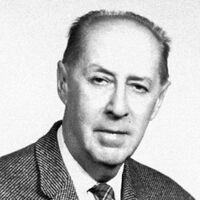
Grosschmid Sándor Károly Henrik (Kassa, 1900. április 11. – San Diego, Kalifornia, 1989. február 21.) magyar író, költő, újságíró.
English202 Magyar982 Română220When life, some human situation, forces you to make a decision, be careful to place your decisions within the framework of the law of change: for all "decisions" take their final shape and form only in time.
Decide, but not so necessarily! Not so at all costs! Not quite so! Give the human decision the leeway it needs to fit into the world and time, to find its place in the laws of human intentions and change. Don't try to fix with oath, nail, and hammer for all time what night and morning change, your heart and intellect are forever grinding, twisting, changing something, today, tomorrow, and forever. Give the resolution time and space to find its true place and form in the world. Decide, but not too much! Decide, but not necessarily! Take action, but at the same time leave everything to time. You will see, tomorrow or a year from now, that it is not you who have decided, but the very volume in which all human affairs are decided: time.
But we say in vain: "I am not touched by the shackle of the world, nor by its praise! All things are transient" - if we do not feel in our souls that we have done our duty to the world. I have often felt this self-reproach. It is not so difficult to renounce what the world offers in vain recognition, entertainment, social or material satisfaction, and to withdraw from people, to live only for our duties and for the small circle of people whose human service we have undertaken. Nor is it easy to do this, nor is it impossible; our retreat is received with disapproval, for they see in such conduct a contempt and criticism of worldly things; we are called eccentric, but at the same time a certain respect surrounds the morose hermit, and this respect and recognition satisfies our vanity. We are also relieved of much discomfort when we withdraw from people.
Yet a voice tells us that we are acting selfishly, conveniently, when we withdraw completely from contact with people, and wander in the desert of our work and our way of life, wrapped in the exalted solitude of the hermit. First of all, in the words of the French, any hermit is suspect who knows the exact timetables - most hermits, out of resentment or feelings of inferiority, know the exact departure times of trains, trains that can take you back to the world! - and around most of the "great loners" there radiates an atmosphere of vanity like the northern lights, which only shine, but do not warm or light. Then, not everyone has the right to be lonely. Only he has a right to solitude, only he has a real right to withdraw from men who can better serve the cause of men in this way. For no one has the right to be lonely out of spleen, out of spleen, pride, or vanity. But if our temperament and the nature of our work, by which we wish to serve men, are such that we need solitude for this, then, only then, may we avoid the company of men. But such a worker and such a work are rare, and the man who chooses solitude should first take a good account of his conscience.
Behind knowledge is monotony. When you know something real about life, you become calm and monotonous.
This monotony does not complain. It doesn't accuse, it doesn't demand revenge, satisfaction or explanation. All that is human is hopeless. Only the divine is complete, only the soul is not hopeless. What can man desire but monotony if he addresses the divine with human desires? The initiated man is silent. He knows that he cannot be helped. All he can do is to do no harm to others or to himself. He who lives towards death, who lives among men, who lives therefore in injustice, what can he hope for? If he can train his heart to a kind of calm and humility, it is almost a consolation and serenity.
In company, we must beware of people who never speak to their neighbours but always to the whole company, who want their every word to be heard by all present, who are stingily careful not to let a single word roll under the table, who are always telling stories, who give lectures to prove their excellence and charm the company. Such people are well liked and welcome in company, because they occupy the minds of those present, and provide an interesting and sometimes jovial atmosphere for those assembled. But these people are false prophets: it is not what they say that is important to them, nor is it important to them to persuade those to whom they speak; it is only the satisfaction of their own vanity that is important to them. The company of such people is to be carefully avoided.
The constant clash between the call and attraction of the world and the worldly performance, which is alien to my being and inclination, has caused me much complication and confusion in my life. For men are social creatures, and this beautiful disposition is by no means to be despised in them: it is right that men should seek each other's company, and learn each other's views in intelligent and friendly conversation, and if they get nothing more from their meetings than a temporary relief from the loneliness of life, this alone is worth the little trouble and inconvenience which such meetings cost. Man is a social creature, and it is in company that he most often unfolds the fine qualities of his character: he who converses fairly and patiently, who endeavours to learn his fellow-men's views of the world and of human destiny in thoughtful and pleasantly phrased dialogue, who answers objections patiently, who does not judge prematurely, who phrases his answers well, and who then, out of accommodation and courtesy, refuses to depart from what he has come to know to be the truth: such a man, in fact, performs the most beautiful of human duties when he goes out into society, and there learns the opinions of his fellow-men, and does not keep silent about his own. But most men are driven rather by vanity, by a desire to escape from boredom, into the circle of their fellow-men; and it is very rare that we have spent a time among men, and afterwards felt no remorse, as if we had been the partakers and accomplices in some debauchery or revelry. Great care must be taken to avoid invitations to houses where the householders expect some mark of social or professional distinction from the "company". In such social gatherings, the invitees are seen as a kind of rare commodity to be sold by the householders in the marketplace of worldly vanity.
I have always avoided social life, its high worldly or artisanal versions. Nor did I resent having to offend people who invited me to their homes for the sake of their vanity or misguided ambition. "To "invite" is a great art, it requires a great deal of spiritual nobility, tact, knowledge of people and situations. And to accept or not to accept an invitation: it is a question of character, like all human questions.
The real cause of most human misfortune, misery, hopeless, shameful and unfortunate human situations is most often not the evil of people, but simply stupidity. That certain "slothfulness for good" of which the Bible speaks. A murderer is a rather rare human phenomenon. Murder requires strength, personality, imagination, great passions. Murderers can be defended against. The more common one, the one against whom there is no defence, the one who breeds human misery and tragedy by the millions, is the pious and tuneful man who turns his head when he sees something vile or unjust, who does not pick up the phone, even if he could help by this warning, he walks carefully round human misery and passes it by without a word, when he could, without any great sacrifice or effort, restore a man's zest for life or help a wretch. The man who goes to war with the world for his own tyranny is not so dangerous as the polite, sly and prudent mediocrity, the humming mediocrity, the cowardly and lazy selfishness. That is the cardinal sin. This is the kind of man who makes the world what it is, and to him we owe it if, in the light of this experience, we bid farewell to the human world at the hour of our death without any particular regret.
To believe that we can retreat from passion is as madness as seriously believing that we can build a house of sand and shelter in the middle of the desert from the simoom.
Passion is as much the reason for our lives as reason, moderation and prudent defence. Only he who can give himself over to the passions of his body and character with the moderation and sincerity of his nature can be a complete man, and one who can be a man of intelligent obedience to the order of nature. But he will not be an animal, because he knows the limits where he must cling tooth and nail in the gale that has overtaken him, to the limits of reason. Do not deny the body, but treat it with dignity and superiority, as the trainer treats the beast. Deny not ambition, but mark its limits. Do not deny the senses, but walk and wake in the rebellion of your senses as a captain among the mutinous sailors of a ship in a storm: with rigour, understanding, unquestioning and heroic. You cannot do otherwise.It is the best a man can do.
The question of whether experience is a shield against the cheap or dangerous temptations of life, which speak with great force, must be answered with denial. Such temptations are false ambition, the temptations of the passions, such as love, acting, worldly success, the temptations of the senses, the excesses of food which are injurious to our health, drink and intoxicants, the passions of the flesh, and even more injurious and dangerous spiritual and moral aberrations, such as revenge, lying, greed. All these dangers and temptations haunt man with obstinate recurrence at every age. Experience, which teaches us that every exaggeration, lie and impure intention leads to disappointment, stumbling, humiliation and sickness, does not prevent us from falling prey to these temptations. Only fidelity to our character, not our experiences, can keep us from falling. There is no absolute good and evil in nature; but there is necessarily evil to man which we cannot reconcile with our character with impunity. Here, then, as always, when we have to decide, we do not inquire whether the temptation offered is good or bad in itself, but only ask, whether what we are about to do is compatible with our character. Worldly experience is not so important as a thorough and unquestioning knowledge of our character. There are inexperienced men who are true to their character and therefore do not fail the worldly test, and there are old, shrewd foxes who cannot adjust their desires to their character, and therefore fail every time and fall shamefully on their faces.
And because you are a wanderer, every day you must continue on the path that leads you towards your only goal, that is, towards the knowledge of your soul and the divine content hidden in your soul. It is not easy. Just think of the many temptations that call you to rest, to interrupt your journey, to take care of something else! A beautiful woman stands on the roadside and beckons you with a charming smile. Your body and senses respond to this call, you want to mingle with this beautiful body and surrender to the sweet intoxication of lust. But you must know that moments of vanity and lust are followed by moments of utter desolation and perplexity. For your soul wants something else, and when you feed your body with the sultry spice of another body, the soul is left hungry and thirsty. Money, medals, titles, titles come in your way: but what do you do with all this when the attention, the fatigue, the time, which is the price of worldly recognition, distracts the best powers of your soul from the knowledge of the divine? Mates whore by the wayside, call you along, and encourage you to a good venture: what can you gain in all business and amusement, if you linger by the gaming table or the tavern table, and your soul asks with agonizing urgency, 'Why are you stealing time here? It's all childish and mean. You must move on, you have work to do." That's how life speaks to you, every day, every moment - it calls you to rest, to lust, to have fun, to be satisfied in vanity and power. But when it's not your job! You're a wanderer and every day you have to keep going. You don't know how long you will live, or even if you will have time, to reach the end of your journey, to know your soul and the divine. Therefore, go on every day, wounded and poor. For you are a wanderer.
The passing years, the older age, do indeed give us something worth enduring, even the many hardships, humiliations, and painful struggles of life. Not only do they give experience, because experience alone has little educational value, as we see everywhere in life: people, even with certain tragic experiences, make the same fatal mistakes, even if they know the consequences in advance. No, the great advantage of old age is that we can build up a system out of our experience, if we are not quite stupid or mean, and do not wish to be the gray hair clowns that people laugh at and despise in our old age! Like the wanderer who, in his wanderings, has become acquainted with a complex mountain system, who, on reaching the highest peak, sees the structure of a landscape, who examines the geological laws of a continuous series of mountain peaks, we too, with the passing years, see the system in everything that happens in our lives and in the lives of others. This overview, which only the passing of years can bring, is the greatest satisfaction we can gain in learning about things human and mundane.
You must not live by superstitions. Friday, the thirteenth, bewitchment, the quackery explanation of numbers and signs, were brought to our world by the Gnostics, the flocking to early Christian Rome of the wacky and rambling sects, the Syrian and Alexandrian tricksters, the cross-eyed wordsmiths, the foaming at the mouth and the sneaky fans. Young Christendom has not yet had the power to beat those who beat you with their eyes, for Friday it says, 'A day'", for thirteen, 'A number like all the rest.'" It was a confusing and fermenting time. The Stoics were no longer in command in Rome, the Christians were not yet ruling. Man stood abandoned in the face of his nature and of nature itself. He was afraid, he was scarce, he was superstitious, he was magical. You're human, you have faith, you know there's order behind the phenomena, a higher intelligence. Reject the superstitions.
But know also that the proud consciousness of your intellect and faith does not discipline and intimidate the more secret forces of the world, which steal and prowl around you from birth to death. The accident, the interplay of numbers, the law of large numbers, the incomprehensible intentions and designs of earth, the air, and the rays, are all unseen. Some humility and trembling you may yet retain in your heart. The world is not only bright and dark, no; the world is also murky. There are not only rays and light and heat; there are demons. (Goethe believed in demons.) The world is not only sensible and consistent; somewhere in its phenomena lurks magic. You must not be superstitious, for it is not fit for man. But you must not despise superstition altogether, for it is superhuman, indecent pride. Rather, one should treat one's superstitions with only gentle mischief, as one who smiles - but is also a little afraid.
Man, in his immense arrogance and vanity, is willing to believe that he can live against the laws of the world, that he can subvert them and rebel against them with impunity. It is as if a drop of water said, "I am not like the sea." Or the spark: "I will not be burned by fire." But man is nothing but a mere part of the world, as perishable as milk or bear meat, as everything that appears one moment on the world's great market and then, the next, is consigned to the garbage or the cesspool. Man, in his corporeal nature, is not even a high element in the world; rather, he is a miserable aggregate of materials doomed to perish. Stone, metal, too, lives longer than man. Therefore, all that we represent to the world through our bodies is insignificant. Only our souls are stronger and more permanent than stone and metal - so we must never see ourselves in any other way than in the volumes of our souls. The strength that expresses itself in the perishable bodily fabric is not only a part of the world, but a meaning. This force is the human soul. Everything else we represent and display in the world is ridiculous and pathetic.
There is no right to any behavior that seeks to build a way of life and an agenda outside the human order. For man, the things and actions of the world have meaning only as long as they seek to influence men and interact with the human world. This cooperation can be direct or indirect. But no one has the right to live for his own sake, indeed, he has no right even to create.
I mean: we have to maintain our authority over our emotions. Only with great care, fairness and experience can we remain masters of our senses. He who is violent with himself will fail. It's a wild herd, a herd of senses. They fight man with every weapon, like catch-as-catch-can wrestlers, respecting no rules of the game, kicking, pinching and biting. There is something both fearful and magnificent in their rebellion. Man lives as long as he has passions. But passions can be educated. Selfishness, lust, carnal hunger and thirst can be humanized. Greed can be transformed into a useful human will. Just as wind, fire, and light can be tamed into useful forces fit for human service - even if they are so powerful in the world, whipping the sea and burning forests and cities, man is stronger! -, so may the forces and passions be restrained which pervade the human body, and rule our hearts and nerves. These wild forces can be trained for human service. To do this, it takes a great deal of experience, a great deal of sorrow, a great deal of will and superhuman strength.
In parallel with knowing our spirit, we must also know the nature of our body. But only as the nature of a bad and unfaithful servant. Our spirit is master, our intellect commands; the body is but a servant. It must be treated, too, intelligently and fairly, impartially and rigorously, as a servant who is at all times prone to disloyalty, to flight and rebellion.
We must know his nature, and his inclinations, and, as far as possible, reconcile him to the world, to the possibilities, to the ebb and flow of the eternal rhythm of life. He is a servant and quite childlike. The inclinations of our minds are as primitive as the demands of a small child. The body wants everything, every pleasure, every satisfaction, and it wants it constantly. It must be treated with severity at such times. But the stuff of which it is made is akin to earth, water, and the stars: there is something eternal in the body, yet at the same time it is ridiculously perishable and fleeting. In the very short time that this servant is at our disposal, we must know his nature and quality, his secret needs, and with benevolence and experience give him all that he may need to do his work and not disturb our character and reason. But the character must not tolerate any slave rebellion.
The real experience for man is first and foremost this: to know himself. To know the world is interesting, useful, delightful, frightening or instructive; to know oneself is the greatest journey, the most frightening discovery, the most instructive encounter. To go to Rome or the North Pole is not as interesting as to learn something real about our character, that is, about the true nature of our inclinations, our relationship to the world, to good and evil, to people, to passions. When my intellect was mature enough to do that, that was the only experience I was looking for in life.
The most interesting phenomenon we can encounter in human life is human character. Nothing is so interesting, so surprising, so unpredictable as the process by which a man betrays his character traits. Whatever the world has to offer: landscapes and natural wonders, the immense variety of the earth's flora and fauna, nothing is as unique as the character of a person. When our interest in the things of the world leads us to a knowledge of human character, we feel at once that this has been our real task in life. Everything else we have come to know has only enriched our knowledge. But our souls are only enriched by the knowledge of character. For this is the most direct human experience, yes, the character is man himself.
And because character is man, it is useless to try to conceal it: character can no more be concealed by man than his physical being can be concealed by any veil of mist. We may wear false beards and disguises from time to time in life, but in a moment all the disguises will fall away and reality will be revealed. A gesture, a word, an action can finally reveal our true character: the masquerade ball can only be a casual affair. And the encounter with the true qualities of a character is the greatest human experience we can have.
Every sage whose thought I have ever known has taught me that we should live and write as if every action we take in life is our last as if every sentence we write is followed by death. Only the awareness of death without emotion, without fear, without unwise cowardice, gives our life and our writing a true attitude. We must live and write in a fatal way, that is, calmly, very attentively, with equal attention to the world and to ourselves, to our intellect and our passions, to the intentions of men and to our relations with the universe. This is the only conduct worthy of man: God requires no more of us. And there is no greater sin and vainer temptation than to want more or less than God requires of us.
The value of life can only be given by the service we give to the cause of the people. This may sound a bit harsh and general, but it is the only truth I have come to know with all its consequences. No one can sit in the flower field, like Ferdinand the bull, and smell the beautiful flowers with impunity. You are a man, therefore you must live like a man and among men.
You live like a man if you live justly. If at the bottom of all your actions and words is the intention: not to harm people. If you try - without ostentation or vanity - to help people. Sometimes just by not being silent about simple truths. Sometimes just by not telling what others lie about. Sometimes just by not saying yes when everyone is shouting, "Yes, yes!" A lifetime of consistently not agreeing with what people lie about is greater heroism than occasionally protesting it loudly and banging your chest.
On your deathbed, you will rest easy only if you have served the truth every day, with all your consciousness. Sometimes justice is very simple and petty. But you do not be picky. That is the value of life.
Reader, this book wants to be honest. It is written by a man whose knowledge is modest and finite. This book wants nothing more than all the countless books that have tried to speak of man's destiny in the world in ancient times and in the recent past. It wants to tell a man how to live, eat, drink, sleep, be sick and stay healthy, love and be bored, prepare for death, and make peace with life. It is not much, because man in general, and the writer of this book in particular, knows little about anything but himself and the world. But it is enough for a human task. We cannot aspire to more in life.
This book will therefore be honest, reader, and will not talk about ideals and heroes, but only about what has to do with man. The author does not want to teach when he writes this book, but to learn. He wants to learn from the books written by the wise and the initiated before him, he wants to learn from the life of men as far as he has been able to observe and understand it, he wants to learn from the signs of life, that is, from the letter, from the human heart, from the herbs and from the signs of the heavens all at once. Because all these together shape human destiny. It is not a book of science, just the kind they teach in elementary school. Whoever wrote it does not know the absolute truth and is often wrong in the details. Because he is human. Yet he seeks the absolute truth and is not sorry when he is wrong in the details. Because he is human. So this book will be like the old herbariums, which tried to answer questions about what to do when one's heart hurts or God has forsaken one with simple examples.
And he who knows better must speak better.
Recommendation: I recommend this book to Seneca because he taught us that without morality there is no man. And to Epictetus, because he taught us the power we have. And to Marcus Aurelius, who learned from Epictetus what is in our power - and was patient. And to Montaigne, because he was cheerful and didn't care what happened to his work after death. And to the Stoics in general, who comforted me when there was no consolation on earth, and taught me not to fear death, nor slavery, nor poverty, nor sickness. And one or two men who were my friends and true men. And one or two women.
This book is like the old herbariums, which tried to answer questions about what to do when one's heart hurts or God has abandoned them with simple examples. It doesn't talk about ideals and heroes, but about what has to do with man. His writer wants to teach his fellow human beings through learning, by learning from the ancients, through the human heart, from the books, and through the signs from the sky. He wishes to impart elementary knowledge of the basic truths of human life. Written in 1943, Sándor Márai dedicates his work to Epictetus, his beloved Marcus Aurelius, Montaigne, and all the Stoics from whom he learned about power, cheerfulness, and a life without fear.