
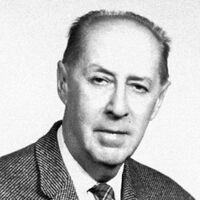
Grosschmid Sándor Károly Henrik (Kassa, 1900. április 11. – San Diego, Kalifornia, 1989. február 21.) magyar író, költő, újságíró.
English202 Magyar982 Română220Two billion and a few hundred million people live on earth, so they say. So know this: there are two billion and a few hundred million chances that your word, your action, will be misunderstood. The number of people on earth is the number of chances and possibilities of misunderstanding. That is the great and the fearful thing about human life, that is the fatal thing about every human manifestation and every human enterprise. You say "white" or "black." But there are whites and blacks in the world, right? And black is different in the eyes of a white man than in the eyes of a black man. And infinitely differently reflected in every human soul in the world. Every word spoken, every word written, has a different ring in the souls of two billion and a few hundred million people. You must know this too, and never be surprised at the echo with which one man responds to another man's word. Human life is an eternal cycle of endless misunderstandings. The sum total of these misunderstandings is the colourful, complex, fearful and magnificent miracle that goes by the collective name of man.
Avoid them as much as possible. Because they are worse than traitors. For there is indeed no excuse for the traitor: a rope for him. But he who, with a cautious self-preservation, loiters about you and the common cause, and has neither courage nor morality to remain alone, nor to bear the consequences of action, treachery, or revenge: these are indeed the most vile. The traitor at least acts: he betrays. His action has consequences, which are borne by both the traitor and the victim. Betrayal is a vile act, but it is an act. But the cautious, who with plain countenance are there for the common cause, and are not brave enough to retire into utter solitude, the doer, the heroic, but not brave enough either to defend or to betray the cause under whose slogan they prowl among men, these, whom every man feels to be on his own side, and in reality are never men or heroes enough to show themselves with all consequences: they who are cowards to treachery, weak to revenge, and powerless to solitude, are the most dangerous. You may despise the traitor. But do not despise such a man, nor pursue him; look over him as through the air.
I've noticed that it's hard to even light a fire. To light a fire in an tiled stove with ignition kindling, newspaper and dry wood shavings, which will keep alight in the cold stove, requires skill and practice. You think it's some simple and menial task that every dirty servant can do. But try it, you, with your wise and practised hands, and you will see what a difficult and delicate task it is, and how much experience and skill it requires! I can't light a tiled stove, no matter how hard I try. And how many things I can't do: for instance, play the piano, only as well and as well as a sad music clerk in a nightclub; and yet how openly and proudly I dare to talk about music! And I cannot drive a locomotive. And I cannot repair a detached button. But all this little knowledge makes up the world. Learn to respect every human movement and dexterity.
Don't count on anyone. You're not even loyal to your job anymore, if you're counting on someone. You no longer even do your job to the full, unconditionally, to the death, which your fate has entrusted you with, if you accept someone's help. There is no one to help you. No one can protect works, people, nations, at the last moment, no one can help, only the work, and the man, the nation itself. The same force that creates a work of art, builds a life, is the only force that can protect you. Therefore, it is best to remain alone. He who is truly, resolutely lonely, who does not cry in his soul for this loneliness, only he is strong. One must not be sentimental or hopeful. In the end you must die, know this. So what are you afraid of? What can you hope for? If you're faithful to your work, death can't do anything against you until you've finished your work. Know this, and be bravely alone.
We must train our minds and our perceptions to see the unique, the wonderful and the visionary in the ordinary, in the everyday. For miracles are not some moment of heavenly noise, when the heavens open, horns blare, mists float, graves open, and the word of God is heard in the confusion: no, most miracles are quite silent. It passes from one room to another, and you see something: the expression of a man's face; the disposition of an object; and at once the true meaning of that object and its relation to the world is revealed to you; you hear a man's voice as never before, and beyond the indifferent words you understand the secret of that man; that is all a miracle ever is. Not to dive into reality, into the everyday, to see what you have seen so often: this faculty fades in most people, just as the ability to operate certain senses, such as smell, fades in civilised man. See, smell the miracle, right where it is. It is always nearby. Most of the time it is so close, so within your reach, that you will never think of reaching out for it for the rest of your life.
Because talent is scarce. Intelligence is also in short supply. Education is not enough to be an artist. It all requires a destiny that cannot be misunderstood and cannot be altered by any human power or will. In every genre there are many talented people who, in fortunate moments, by the effort of their talent, their deepening, their seriousness, end up creating something useful, sometimes rare and beautiful. This is how world literature, or painting, or music as a whole, is put together as a work of art. But these men are not creators, only executors; for they have no destiny. And if they happen to stray into a medical or engineering career, they will still create something talented and useful. But the artist, the real one, cannot "err" into any career, and there is no historical or situational force that can divert him from his task; he can be no other than a writer or a painter or a musician. He who is thus an artist is doomed. That is the maximum.
We have to be very careful of people who have been blessed by nature with talent, but who have not been given a meaning for that talent. They are the most dangerous competitors of any profession and of human coexistence in general. For with the less gifted but intelligent man it is possible to co-operate, but with the man who is gifted but stupid for his own talent there is no agreement. The man thus blessed and beaten is ever suspicious that something will turn out; and his suspicion is justified. At last he is indeed found to be stupid, and this sad handicap reflects on his work and talent. Just as a very beautiful woman, who can smile wittily and pout enchantingly, is no longer so beautiful the moment she is revealed in conversation to be as dumb as the dark night. There is beauty without meaning and there is talent without meaning. These are perverse fairies. So many Celemen Masons: what is built by day is demolished by night. And they are extremely suspicious. A man of sense, without particular talent, can be of more use to the world than a man of talent without sense. In the end they become prophets: so I have experienced.
Like on the bonfire, you must burn. As one who knows he is being burned for something, and cannot and will not do anything about it. It is not enough to know the truth, it is not enough to formulate it, it is not enough to say it boldly: one must also burn for it, burn, throw the very fabric of life, the very tissue of the body, into the flames that burn simultaneously from within and without. This bonfire, which in the end every man who wants the truth must stand before, is built by two: the executioner and the victim. There can be no agreement in the end. All practice, experience, caution is in vain. Nothing helps, you have to burn in the end if you want to keep something of what was the meaning of your life.
What is evil? It is an extremely complex phenomenon. Behind cruelty are mostly childhood traumas - but there is of course more behind it, a combination of character, physical and mental make-up, bad examples. Thousands of years of education have not been able to dissolve the tendency to cruelty in man. Animals, beasts are never cruel, with the exception of the one cat. Evil feeds on ingratitude; then on ignorance. The man who is prone to evil knows no "owes" and "demands" in the accounts of his life: he only demands. I do not believe that by kindness, forbearance, teaching, we can dissolve in such a man the impulses of wickedness and cruelty. He who is born evil - there are some - or who has been brought up by life's disappointments, experiences, cruel turns, not to patience and forgiveness, but to evil, is lost to all moral reasoning. It is best to get out of the way as much as possible. And one can also pity him, because most of the time a cruel, selfish and stupid mother or a wicked father is behind the dark background of such a person's childhood.
The sovereign man, who has devoted his life to the proclamation and practice of the truths which he has come to know and to accept with all consequences, is naturally always modest and courteous. Even when he proclaims the truth. The chief mark of a sovereign man is that he fears nothing but his conscience, and at the same time is not offended by anything. For he who is offended is neither courageous nor sovereign. He who fears and is offended cannot consistently, to life and death, represent a truth in the world. He who is offended, quarrels. A sovereign man never quarrels, nay, never even argues. He speaks his truth, and then stands his ground, to the last moment, and accepts all that follows from the truth and the impatient misunderstandings of the world. Everyone else just swallows. When you have rank, you must not be afraid. But it is only the untrustworthy who are offended, and those whose opinions of the world are more important than the truth.
You don't have to be a fakir and live according to the laws of yoga, a yogic and forced practice: but I think it is right to stand at the open window at dawn, after waking up, and breathe deeply through the nose a few times, filling the lungs with fresh morning air, washing and clearing the lungs of the impure vapours of tobacco smoke, of the room air. Something must be given to the lungs. The body is very grateful, eager to acknowledge the slightest attention. And I've found that honey is useful too: for your breakfast, which can't be light enough, spoon some pure honey. There's something in honey that the pure forces of nature smuggle into it; the body gratefully receives it.
In life and at work, be careful not to be tempted by the trivial, the casual, the convenient. There's always a chance that will relieve the tension of the effort required, offer a side trip, a cheaper option. Talk about the essential, write the essential, act the essential. It is always harder, it takes more life force - and yet, when you resolve to give the situation or the work your essential effort, you find that it was the simplest, yes, the only possible solution, the perfect one. The incidental, the half-solution, the cliché, the evasion, the evasion, the evasive artifice, ultimately requires more and meaner effort than the essential, the simple, the perfect. When you take the middle road, you waste. The essential is always cheaper, more useful, more effective. Live economically, create frugally, spend your energy on nothing but the essential.
Think always and ever that the people who approach you are both guilty and innocent, and that the same law is at work in their hearts as in yours and in the minds of the universe, and that they are as mortal as you are. Human wickedness and human goodness are alike a current and a part of the world's rhythm of life. I can no longer look upon the greatest evil-doer - nor the one who makes an attempt on my life - as any other than an instrument of the great unity of life. He attacks my life, but he is also a victim - what is there to hate about him?
Not very long afterwards, not only are your name and your person completely and utterly forgotten by the world, not only is the memory of your work covered with the dust of oblivion, but the material of your work is also decaying, the paper and the linen binding of your books are vanishing into nothingness, the pictures you painted are no longer visible anywhere in the world, and the marble statues, your works, have been crumbled into fine dust by time. All this will most certainly happen, and only seconds will pass on the clock of time before you and all you have meant to the world will be utterly and permanently destroyed. What then can you fear in life? What is so important or dangerous or regrettable that you should shrink from the truth? I do not understand you.
You don't believe in miracles, do you deny it? Look, I can't convince you, because the main characteristic of a miracle is that it is miraculous - it cannot be proven as a physiological fact, it cannot be photographed, nor can it be predicted and calculated in advance according to the laws of quantity. Nor is it always easy to perceive the manifestations of a miracle: it does not always walk on two legs, it cannot be photographed, it has no land registry or birth certificate. Sometimes it is only much later that we understand what the miracle was, how it intervened in our lives, and what was supernatural and wonderful about this intervention. I cannot show or prove the essence of the miracle. But think, perhaps, how incomprehensible and wonderful is in reality all that you feel to be everyday and natural: how miraculous the very fact of existence is! To be born, to live, and one day to die! Does all this feel "natural" to you? Then you are blind and deaf. Reality itself is a miracle, incomprehensible, and supernatural with all its natural props and materials! Why should a miracle be more meaningless than this improbably complicated reality? The universal spirit is the miracle that manifests itself in everything. This is why I am a believer: because the spirit of the world is manifested in me, in my daily life, in my sad and fallible fate.
Because when you speak the truth - the simplest truth - you must know that immediately flames ignite around you: flames of passion, of accountability, of resentment. He who speaks the truth walks through a sea of fire, and he is right to put on a kind of asbestos garment, otherwise he will be instantly consumed by flames. This asbestos dress can never be anything other than an impassive and unquestioning calm, an inexorable calm of commandment and service: you can do nothing else, you must act as you are, even if you are burned. The writer is always slightly burned at the stake. Sometimes he is roasted with a slow fire, sometimes with a fiery flame. And like the fakirs who, in their obsessive faith and cold trance, walk barefoot, unwounded, unfeeling, through the fire-pit, the writer is protected from third-degree burns by nothing but his faith and obsession, which is quite cold, unrelenting and unforgiving, both to himself and to others. Put on this asbestos suit, speak the truth, walk through the flames.
People, of course, always want the writer, the explainer, the explicator, to speak in their interests. The writer cannot fulfil this wish, because human interests are inextricably and contradictory: the writer can only ever express the truth, or at least that is his intention. But, at the same time, when people eagerly and impatiently demand that the writer should speak for and on their behalf of whatever is in their interest, they also expect him to be unrivalled and uninterested. Therefore you must know that you can never please them: if you serve their interests, you will lose yourself, if you are impartial, you will lose the favour of the people, if you tell the truth, they will not examine and criticise what you have said, but will discover shortcomings in your work, will object that you did not say this or that, and will question why you did not say it?
No one asks a milliner to make shoes, no one asks a cobbler to make a hat: but everyone asks a writer to do everything, with equal fervour and impatience. Therefore, never listen to anyone but your soul and the Angel.
Barbarian rule is always followed by Byzantine rule. A kind of human, historical, law of the peculiar order of human nature dictates that the transition from crude invasion and conquest, from confusion to an over-refined, corrupt and contrived order, full of servile ceremonies, poison, murder and smooth talk, double-tilted, stuffy politeness and bowing cruelty. Such is man: sometimes barbarian, sometimes Byzantine. And sometimes, at very rare periods, under the educated rule of an extraordinary personality, who can reconcile the rigour of perfect law with the unwritten laws of equity, he is tamed into humanity; but these are rare and fleeting periods.
I can never understand why the most beautiful memory of my life is the moment - I must have been ten years old - when I entered my mother's dark, empty bedroom one winter afternoon and, standing in the doorway, I saw the bluish reflection of the snow glowing across from the rooftops of the houses on the opposite side of the street, on the polished furniture and the stove tiles by the window. I cannot forget the magic of this moment. The blue glow of the snow in the dark room was a real shock, but at the same time it filled me with a feeling of happiness that I had never experienced before or since. I had never known this total enchantment of the mystery, the fairy tale, the dreamlike, the otherworldly, the enchanted, until then, and I never later found it in my life, never, nowhere. What happened then in my heart, in my nerves, or in the world? I cannot explain it. The miraculous cannot be explained. And a memory like that is eternal in a soul, as fabulous and bluish as the snow on the rooftops opposite my mother's bedroom.
Stay away from laxatives. And if you're forced to live with them because of a pounding headache or acute indigestion, settle - rarely - for a glass of warm bitter water. There is some violent intent in all these preparations to interfere artificially with nature's order of life. Behind intestinal constipation there is mostly stinginess, some kind of spasmodic greed, feverish ambition; then there is the dull way of life behind it; behind intestinal consipation is the stinginess of life and of a man, completely and utterly. If you are constipated, why hope that your digestion will be agile? Behind every complaint lies the character of the whole man. Be at peace with your character, and you will be at peace with your digestion.
When you go away, don't try to turn your hotel room into a home. Some people are desperate to take the things they want and need back home with them on their travels, and would prefer to take a canary, a rocking chair and family photos with them, so that they don't have to go to a foreign host's room without the artefacts of home. These people are fussy and childish, forever longing for the nanny and the cradle. The seasoned traveller hopes for a temporary, raw experience of freedom, a kind of rugged unpredictability, a surprise of reality, and does not want to make a hotel room a home, a warm feathered resting place. And a man who knows his heart, the world and the nature of human things, lives in his home as in an inn, and does not clutter the room where his passing life passes with unnecessary, sentimental or vain junk. Such a man also lives in his home as in an inn; for what is there to live for? A bed, a table, a chair. And you are a traveller, a wanderer, even in your tenement. Always think of this when you lay down at home or in a stranger's bed: in the morning you must move, the Landlord may give notice. That's why you don't need - ever, anywhere - a canary or a rocking chair.
When the century was young, I was young; and because we were young, of course, we were both revolutionaries. Then time passed, and the century, and its children, entered manhood; and they wanted to grow old wisely. I wished to put on slippers or a saloon coat; I wished to throw away all the slogans of the revolution, because time had ripened them in my heart and in my mind, and I knew that liberty, equality, and fraternity were not as perfect ideals in practice as I had believed when I was young and a revolutionary. I already wanted to talk about the fact that it is more difficult to preserve than to throw away the old and create a new one from the pots; I already wanted to reconcile with the people, to build order, to bring in all the flags. But time has not allowed me to do that. And I had to know that I must remain hopelessly revolutionary, because the generation that follows me is, mysteriously, not revolutionary at all; I have no one to whom, in the order of nature and human affairs, I can hand over the flag; I must remain a protester and a blockade-maker, because I live in an age whose young people willingly assume all the limitations that the century and I, when we were young, did not assume.
Toothlessly and with a greying hair, I am forced to remain a revolutionary who stubbornly repeats the promises of freedom of thought, equality and fraternity, in which he perhaps no longer believes so absolutely. I must remain a sans-culotte* even in my old age when it would have been so nice to have worn a saloon coat for once!
* - in the French Revolution, people who wore long trousers instead of knee breeches; consistent supporters of the bourgeois revolution
You're about to do a great deed. You have decided to say what you have come to know. You want to shout out the secret, innermost conviction of your life. You're going to stand up in front of people and make a decision - you're going to speak the truth, finally. You take the fight, you throw away your scorn, your house, your home. Yes, you are determined to stand up in front of the world, with all the consequences, and speak the truth. All this is very beautiful. That's man's job on earth, that's his real job. Just remember one thing: the world is also a terrible distorting mirror. It's like those curved mirrors in the panopticon that show the tall man as a dwarf and the fat man as a starving man. You cannot expect that there will be a single person in the world who will understand your words, and your actions, understand and explain them exactly as you have conceived them. Only you always know what you really meant; the world always understands and sees only what your intentions are perceived and reflected by the mysterious distorting mirror of human reason. Therefore, never cry, "They did not understand! How wicked they are!" Always say only this, "I will such and such, but the world has understood so and so." Because this is the truth.
Love can be given and love can be received. There is only one thing you cannot do: extort love. And most of the time, the poor and unfortunate who are hungry for love don't know this.
It is obvious that one either loves or one is loved: this alternating current has been organized by nature with unrelenting consistency. The most perfect and fortunate form of harmony is when one tolerates being loved by the other without any particular rebellion. Nature is, after all, merciful: it is true that it never allows us to be loved by the one we hope to be loved by, but it does allow us to love without limit even the one who does not love us. But it does not give us a way to do one thing: to extort love from others by begging, accusing, attacking, or pleading. Even tenderness and passion can be extorted, but love is sovereign.
Make sure that the idea never carries you away and doesn't force you to create prematurely. Because an idea is nothing. Even a dog has ideas. Every dilettante notes is full of the finest literary, social, political ideas. The "good idea" flashes because you have read, heard or experienced something, because some worldly fairy has touched the surface of your soul - and you are already sharpening your pencil and turning the idea into a work, swelling it into a creation, which is nothing more than an idea! Beware, for this temptation is common in the life of the creative man. It is not only the works that need to be put to rest for years; the ideas too. If the idea doesn't turn into an experience, throw it away, no matter how clever, tempting and appealing. The experience writes itself; you write the idea. And that's not right.
To the extent that people have given up their individual sense of self in servile humility, their professional sense of self has increased. In my time, the vast majority of people tolerated without a murmur the systematic deprivation by the State, the Office, and the Institution, of the God-ordained privileges of their individuality. Did they tolerate the soulless, vicious, and rigid order of a civilization telling them how to live, dress, entertain, and enjoy themselves, indeed, in this age, even telling them how and when to walk the streets. They were forbidden to think and speak on command. They were forbidden to have an artificially inflated power interest, called Party, Office or Principle, interfere in every aspect of their private lives, to shape and mould their character and thought. All this was tolerated without a word, without contradiction. The individual could be trained by all; he obeyed in silence. But this same tamed, domesticated man, deprived of all human prerogatives of individuality, would thunder if anyone dared to criticise the profession to which he belonged. You could say what you liked about the coppersmith, and he would bear it with taciturnity and blinking patience; but if you dared to speak of the Coppersmith's Trade, all the coppersmiths of the world would immediately start shouting and protesting. It was the same with clerks, writers, doctors. A dentist silently tolerated being called stupid in private, but immediately appealed to the World Dental Association if anyone dared to prove publicly that dentists were not the most perfect, blameless people on earth. The individual pocketed everything, the profession gnashed its teeth. I experienced this too.
Few concepts have been circulated as boldly and as inconsistently in my time as the notion of a "sense of community". There are people who, one may rightly assume, have never given twenty pennies to a beggar, who, with the slogan of a sense of community on their lips, have stood up for the happiness of mankind, have recited from the barrels and the podiums of popular gatherings. This was the slogan of the front pages of newspapers of eminent public writers whose work in the cause of the community principle did indeed result in something: a fine house or estate, acquired at the price of their work in promoting the community spirit. The only people who did not talk about a sense of community were those who gave their work, their strength, and their lives to the community all the time: the silent people. It seems that the people, the community, have no sense of community. They just live, for each other and the whole, without a slogan.
But as long as you think there's a heart beating somewhere that beats for you, forgive people. A human heart that feels unselfishly toward you is enough to forgive all those whose selfish and wicked hearts you have known; enough to forgive all men. It does not take much to be forgiven in the midst of this hopelessness. One man is enough. Nor is it true that you have not met this man. You were just nervous, or impatient and greedy, and went away. Because you are human, and because that is the human heart.
If I look into my heart and examine well all that I have experienced in my association with men, I must say that all human association is hopeless and that the man who wants to live rightly and to do the personal work to which he, and he alone, has been assigned by destiny, acts wisely when he lives entirely alone. All tender human feeling is in practice transformed into selfishness; it is wiser to remain alone, even if it is sometimes very painful and difficult. There is no woman, no friend, no human relationship that will not humiliate you in time. Stay polite and lonely, because people are hopeless.
You cannot, of course, advise a shoemaker or a good financier, and the vast majority of people in general, to live alone; the great majority of people are meant to live in community, with family and friends, and to reproduce until the end of time. It is the law and it is right. But for the creative man, the real task of his life is not the cultivation of family or friends, but his work, for which he needs a perfectly pure atmosphere. Where people breathe, the air becomes turbid, stifled and impure. Therefore be alone when you are busy, in your work and your life.
Be careful not to miss the moment, which is only your moment, the time appointed for the execution of your work. Convenience, idleness, cowardice, and laziness, sometimes delay the execution of your task, even though you know in your heart that time is full of what it wants to say through you, and you cannot miss a moment because someone else is saying it for you, and not in the way you think is good and true. In science, art, literature, in public life, there are such urgent moments when truth is ripe and needs to be spoken. And if you feel that you have been fated to be the one to do it, do not delay, like the bad actor who misses the cue.
Thou hast not only the work but also the time. And within time there is your moment, which must not be missed.