
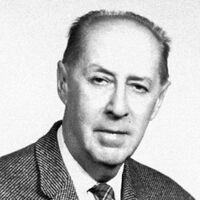
Grosschmid Sándor Károly Henrik (Kassa, 1900. április 11. – San Diego, Kalifornia, 1989. február 21.) magyar író, költő, újságíró.
English202 Magyar982 Română220In life-threatening situations, we must remember that our time is definitely up, even if the touch of the hand of fate is ten years before or after; because the content of life is the great tension, the moments of creation, not the calendar period of existence. You lived when you expressed with all your strength the divine command which was the content of your life, you fulfilled, with fervor and destiny, your duty. This moment was the time of life. Everything else was only preparation and waiting. And nature is economical: she does not let go prematurely those whom she needs for her work; and when they have done what they were engaged to do in the great work of the world, she cares for them no more. The danger of life, then, is plain, have you lived well, have you lived bravely and dutifully? The rest is private, which in the depths of your heart even you do not really care about.
Whatever happens in the world, remember the truth that the state and political power can never be without the power of philosophers and reason. Nor can it do without it when instinct temporarily rules in community life, or when the departing emperors are replaced by praetorians*. Think always of how Aristotle's education of one gifted man became a world empire? The Macedonian empire was founded by Aristotle as much as Alexander the Great. Never delay when you have to prove the power of reason against political and state power. A state without the leadership of reason is but a horde, and such a state, even in the possession of political power, soon falls to pieces. Only the cohesive power of reason can give shape to the human community. The philosopher may be killed by the state, but he cannot live and survive without it.
* - the Roman emperors' bodyguards; the privileged minions of a system
Think about it before you pick up a book and start reading it - at least as much as you would when you shake a person's hand in confidence. Because you give the book the attention of your soul for a time; and that is a very precious thing, for life is short and your soul is yours alone. And when thou hast made up thy mind to read, read it slowly, very carefully and patiently as if thou wert arguing with a fair reasoning. And even if a book or its dull, complicated presentation goes against your taste and convictions, read the book through. But, because life is short, and because books are as many as drops of water in the sea, choose your book carefully before you open it. Read consistently and faithfully, but choose with great care, for you are giving a fraction of your life and your mind to the book you are reading. Once you have started reading, stay faithful to the book, even if it speaks against you, against your soul and your intellect. The book can be an adversary; you have to fight it all the way. But only with worthy adversaries; never with those who, as one poet said, must be given a fencing lesson in the midst of the duel.
This is the human faculty that is most difficult to acquire, this is the quality against which the most secret instincts of our being rebel, because we are mortal, because our time is running out, because our star is running out: this is the most painful duty, to ourselves, to our destiny and to its deepest meaning, to our work. There is no true creation without infinite patience, capable of remaining master of man's innermost nature. For creation is never a sleight of hand, a lightning-fast trick, a gambling sans-sé-passe*, the creator cannot pull works of art out of the cylinders. It is not only the genius: patience - the work itself is patience, the patience of organic development, the miracle of retention and maturation. To learn patience, in life and work, is to learn the secret of the Creator. Digest this lesson, you restless mortal.
* - gambling-expression
If you can, always live to contemplate one of the masterpieces of the human spirit frozen in amber every day, even if only for a few moments! Let not a day go by without you reading a few lines from Seneca, Tolstoy, Cervantes, Aristotle, the Scriptures, Rilke, or Marcus Aurelius. Listen to a few beats of music every day, and if you have no other choice, play a theme by Bach, Beethoven, Gluck, or Mozart on your music box. Not a day should go by that you haven't spent a few minutes looking at a painting or drawing by Brueghel or Dürer or Michelangelo in the mirror of a good print. It is so easy to get all this, and so easy to find half an hour for fine art! And so easy to fill your soul with the happy harmony of human perfection! You are rich, however miserable you may be. The fullness of the human spirit is yours. Live it, every day, as man is breathing.
Don't be ashamed if you love animals. Don't be afraid if a dog is closer to your soul than most people you know personally. It is lying prophets and gross, wicked men who reproach you for this affection, saying, "Steal from men the feelings you lavish on the dog! Selfish, cold-hearted fellow!" - Never mind them. Love your dog, this bright-eyed, tireless friend, who asks nothing more for his friendship than a modest treat and a petting or two. Don't think that tenderness and selfishness make you love animals. They are our brothers and sisters, made in the same workshop as humans, and they have a mind, sometimes more complex and subtle than most humans. Others call animal love a weakness, and mock us for it - you just walk your dog. You will be in good company, and God knows this.
Your attitude to the world and to life should be pathos-free, without sentimentalism. But there is more to work, to create: it requires dreaming, it requires pathos and tide, it requires emotional exuberance. Great creations cannot be calculated with a cold head, on paper, and a pencil; just as one cannot create by speculation at all, nor can one make children according to plans on paper and in pencil. You also need feeling, passion, devotion, and flow to create. A Catholic education leaves much imagination and emotion in the soul, and such a soul may not stand well the hard and primitive trials of the commonplace - its feelings are carried away - but it will be susceptible to the problems of creation. Protestant education teaches dispassion and fatalism, and for everyday use, this is perhaps the most useful. It is true that the self-consciousness of fatalism can only create hard lives; less often and with difficulty, great works. Therefore thou must, on Mondays and Tuesdays, when thou must bury thy sweethearts, or fight with thy impudent adversaries, remain hard and unemotional; and strive to dream, and fear not the tide when thou art creating.
In our work, in our daily life, in the way we respond to the phenomena of the world with our character, our intellect, our taste, there is a kind of internal law in all this, which we cannot arbitrarily circumvent with impunity. You must not want to work in any other way than that which your character, your abilities, and the nature of the work dictate. Thou shalt not wish to be happy, to rest, to undertake otherwise than thy character and nerves command. Adapt yourself to the law, which inexorably dictates your place, your work, and your attitude to life. Everything must be done and accepted in its turn: joy, sorrow, vocation, duty, failure, and death. You must adapt yourself to the incomprehensible and hard law of your life, which prescribes the exact order of your actions, the meaning of your actions, and the heat of your emotions. Do not want to be more clever, more intelligent, more happy, more talented, more unhappy, or more hopeless than you are. The law burns in letters of flame on the facade of the building of your life. Read this law, every day, every moment.
The French say that only those who can see reality have a real imagination. This ability is rare. People believe that fantasy is clear by dreaming up some never-existent phenomenon. But never-before-existed fairies have no hands or feet, they are like griffins, and anything that has nothing to do with reality is boring and childish. True imagination builds the new, the wonderful, the surprising from reality. To see reality is a far more surprising and imaginative enterprise than to build dream castles out of clouds that crumble at the first whiff of reality. Learn to really see a sane man, and you will find that he is more surprising and wonderful than the winged heroes of myth.
When you are hit by a great shock or emotional pain, first of all remember that it is natural, because you are human. What were you thinking? You are a human being, so your loved ones die, your friends leave you, and everything you have gathered and loved flies away like dust in a windstorm. It is not wonderful, it is the order of nature, it is simple and natural. Rather, what's miraculous is that you don't get hit by great misfortune every day. You are human, therefore you must suffer; and your suffering does not last forever, because you are human. Adjust your conduct in sorrow and adversity to this truth. Never show sorrow to the world. Show neither pride nor haughtiness. Do not deny pain to yourself, but know that pain and adversity are always a downfall. People think: "Someone important to him, someone he loved, has died; well, he has fallen." Feel the pain, but don't hiss. On the one hand, when you sigh, when you shed a tear, you are already cheating a little in these moments. The real pain is silent; tears and cries are a relief. So do not deceive yourself, nor make the world glad. Be silent. Control thy face and thy movements. And if thou art alone with thy grief, speak thus: "Here, pain. But however much pain I will feel, I know it is all right: because I am human."
If the headache persists for several days, go to a trusted eye doctor and ask him or her to do the necessary tests on you; only then go to an internist.
Ordinary, everyday headaches are most often caused by nicotine; then by the weather, atmospheric pressure, and temperature changes on days of frontal migration; less often by some dietary fault; and still less often by circulatory disorders. But it can also be caused by nervousness, cowardice, or fear of tasks or situations. For a cold sore, I can recommend the following: drink a cup of hot, strong black tea, darken the room, lie in bed, swallow an algocratine or two, warm your aching skull with a hot electric blanket, and lie still for an hour or two. This method is infallible, and it cures the simple spasm of the blood vessels, the migraine, without fail. For all other types of headaches, consult an ophthalmologist and an internist immediately.
And cultivate your soul to a steadfast existence of need. This is most important. The mass world is only greedy, not demanding. You remain moderate and exigent. The world is becoming more and more like a Woolworth's department store, where for a sixpenny you can get everything, in shoddy quality, that can satisfy the daily desires of the epicurean masses quickly, cheaply, and for pennies. The dangers of this mass consumerism are already showing themselves, in all spheres of life and spirit. A culture is not only destroyed when barbarians appear with hatchets in the fine squares of Athens and Rome but it is also destroyed when those same barbarians appear in the public squares of a culture and engage in a massive exchange of demand and supply of unwanted goods. You be selective. Do not choose gently and with a wrinkle of the nose, but with rigor and ruthlessness. You can't be too demanding morally, or spiritually. You can't be consistent enough to say: this is noble, this is Talmudic, this is valuable, this is rubbish. That's your business, if you're a man, and you want to keep that rank.
Because it is not only laziness for doing the right thing exists. Another vice is the eagerness to do good, the over-enthusiasm with which some people are always jumping out of their seats, or out of their jobs, or out of their circumstances, to do something good - wiping away a tear on the run, settle a death or a marital crisis on the phone, shake hands with a bereaved parent in passing, expressing condolences for the death of a child, and generally intervene, but only so nimbly and casually, in the misery of others. A cancer patient is told to eat lots of watermelons, and someone who is bankrupt is advised to watch Chaplin's latest film. These merchants of kindness and compassion are peddling a poor and not entirely harmless commodity. They give glucose from starch to the suffering. Do not accept their goodness, spit out the cheap candy they offer you.
Somewhere they are waiting, and the time is passing, morning or afternoon, and you are not yet finished with your work. Are you in a hurry? Are you distracted, casually attending to the only meaning of your life, your work, because they are waiting somewhere? Let them wait. No one and nothing is important but your work. Nor is time important - don't let time interfere with your work.
Is the time of day not important, just as it is not important who is waiting and for what purpose? Nor is it important that you can do something for your health by leaving your workplace early, taking a walk in the good weather, or visiting one of the many healthy and refreshing spas where you can revitalize your body. Nor is your lover, the powerful or influential man whose friendship you miss by keeping him waiting. Nothing and no one is important, for you will die anyway, and you must do your work until then. Listen only to that; not to the clock or the calendar.
Most people are fatally wounded in sex duels. His vanity cannot endure love, nor unlove; he suffers from loneliness as well as from cohabitation; he flees to pigsties, or to resentful, revengeful lonely roles.
The only way to remain powerful over our emotions is to learn modesty in time. There are no lasting "sensual solutions"; perhaps not even friendship lasts; nothing human lasts. On the plane of human life, there are no emotional "five-year plans"; there are only situations, which are always imperfect. The "great feelings" are the most violently hurt, and always prematurely. The temporary rebellion of our emotions must be endured as one of life's great trials. We must accept that there is no solution, only patience. And if one is so strong as to transform these passions into nobler intentions, to melt the passions in the crucible of work, to distil the vanity from these forces in the flask of humility: one acts wisely. But this is the most difficult task in life.
On the railway or on the deck of a ship, people feel they have broken out of the ordinary laws of their lives, they start chatting, they are more communicative and intimate, they wait for a miracle, and they blink at their fellow travelers with encouragement and hope. Be careful not to offend them. At their approach - when they turn to you with a clumsy and awkward, but nevertheless touching human hopefulness - they also ask you questions such as, "What do you think, will there be a luggage carrier at midnight in Oradea?" - answer with a smile and few words. Don't refuse them, because in this state of mind, when the train or the boat is carrying them towards the supposed miracle - all change: the expectation of a miracle - they are sensitive. Smile, nod, then turn to your book or the landscape. Don't make them feel there is no miracle. Right, don't make them believe in wonder. Just tell them there may be a luggage carrier at midnight in Oradea. Not a word more.
Herodotus, who so delightfully gossips about Greeks, Persians, Medes, Lydians, the fate of the peoples and leaders of antiquity, advises us not to arbitrarily and artificially defy the fortune that flashes its star in our direction. Every ancient people, the Persians, the Babylonians, the Phoenicians, and every ancient religion, warned the lucky people against their stars. The gods, the fates, do not tolerate lasting good fortune: so Herodotus experienced it on his wanderings, as all the old sayings, religions, and superstitions teach. Thy house is not thine, thy gold, thy wife, thy children, thy health, thy glory, all these are as thine as the chance of fortune in a game of dice. All is thine but for a moment: then the die is cast. The gods want it that way.
That's why nothing is as moving as the story of Polycrates, with the ring, the fish, and the fisherman. Man feels his fate and wishes to escape it by sacrifice. But sacrifice is no help: the gods are merciless. Fortune smiles cruelly at you, and if you turn away trembling, she will chase after you, only to humiliate you and rob you of your fate.
What then is thine, what is thine that the gods cannot take from thee? Only work. The work that expects no reward, no laurels, no posterity. But it will happen to you if you do not turn from it, and care not for its fate. The toil is yours, the sweat, the sacrifice. All else is more volatile than the morning mist, more fragile than the wing of a butterfly.
Tolstoy was right, music is the greatest pimp, the most dangerous seducer. The intellect becomes scarce when it hears music. Music is anti-intellectual. It does not seek to understand, as reason does, but to overflow, to upset, to disarm, to seduce, to touch the secret and the painful in us, to reveal what we have so carefully hidden from ourselves, disciplined by every means - it is like the spring wild water, upsetting the areas so carefully parcelled out, cultivated and worked, regulated and disciplined by reason. Where music spills out, the laws of reason no longer apply. In the beauty that music gives, the sick sensations of the lustful annihilation of the death wish ripple. Music is an attack. The man who has set his life on cognition, discipline, and reality, defends himself against music, and closes his ears. Without music, life is much poorer. But more human, harder, sadder, and more meaningful.
But when you go into the great woods, or into the wilderness, or travel on the sea, and your soul is filled with feelings of majesty and infinity, do not deceive yourself: know that in your heart you are only interested in man, nothing else. A people's café is as interesting as the Atlantic or the Sahara or the pine forests of the Carpathians. Yes, a single man, when he shows his being and reveals his secret, is more interesting than Mont Blanc. Admire the immensity of nature, endeavor to live in harmony with your character and the forces of nature, but do not be ashamed, nor deny that the most sublime spectacle of nature will lose its true interest and charm for you with surprising rapidity if it has no direct connection with the destinies of the people you know. The wild landscape will soon become meaningless and dull if man, the one true object of your contemplation and interest, the one never tiresome object, does not appear on the endless stage of nature. Your business, your experience, your role, and your destiny on this earth is man, not Mont Blanc. The world is but a color and scenery, which you watch casually; your heart and your intellect tremble at the monologue of this suspicious hero. All else is boring sooner or later.
There is something moving about forests, especially pine forests. It's not just their dark and consistent silence that moves me, but their deep shadows, their churchly majesty, and their reverent attitude. It is the will of life with which a great forest expresses the forces of the world that is so moving. Just think what forces and intentions have built hundreds of thousands of fifty-metre pines! What nature has wasted in seeds, dust, buds, experiments, sunshine, rain, and wind, in building such a forest! And how purposeful and silent is this existence that wants nothing more than to be, to grow and survive for centuries, fully expressing itself, breathing, responding to the world - and at the same time not breaking against anyone or anything, giving home and life to billions of living beings. What a great and wise community this fifty-thousand-acre pine forest is. Like the forefathers, the pines watch over life. They answer to the earth and sky at once with their mighty trunks. Whenever you can, go to the forest.
But you also don't always have the right to remain silent; especially when the chatterer speaks, sooner or later you have to answer. Of course, nothing would be more attractive or comfortable than to be silent among people all the time, and to speak to the world only through your work - your work, which may be a book or a pair of decently sewn shoes, or even the fact of a patient and balanced existence. This would be the most beautiful thing, but life does not give the solution so cheaply. You have to listen, but not as one who is silent out of convenience or pride or contempt; you have no right to do so, because you are human, and your fellow human beings have a right to ask you for answers to their questions. No, you must listen as one who guards something. And indeed, he who listens responsibly always preserves something: a secret, a rank, the consciousness of human culture. But sometimes you must also speak, you must throw off the dark cloak of silence, you must step into the arena with a naked body, holding the just weapon of human combat, the truth. If the truth is denied, you have no right to remain silent.
For most people, the compulsion to chatter is obvious in the law of life; they chatter while they live; till they live they chatter; they do not think, they chatter, and they have the impression that they exist. But in fact they are not in reality, in the way that the thinker is; they only babble; and the one who is babbling is not thinking. A man who thinks, when he can, is silent; and when he can no longer be silent, he speaks or writes. But this he does only as a last necessity. Nay, to the chatterbox, rapid speech, by which he conveys to the world all the jumbled information, the alkaline desire, the gross observation, the superficial perception, which his sense-organs convey to his consciousness, is a necessity of life. It might crack if it did not babble. It does not digest the matter of the world; it spits it out and vomits it up, as crudely as it has received it. There is no command, no threat to lock its tongue. It spits out the world, which then becomes unbearable: concepts disappear when the chatterbox speaks, and the world fills itself with words.
And accidents, which do not exist - like witches - are no longer to be mentioned. I do not believe in accidents. There is only carelessness. You get hit by a tram, your luggage is stolen on the way, an impudent blackmails you and insults your name, and you spoil your stomach with food and drink - and then what? Why weren't you more careful? The world is dangerous, and the possibility of accident lurks in every situation and action of life, this danger and chance is clear with human life. Yes, perhaps it is this chance that gives one a deeper hold and tension. Just think, what would human life and the world be like without the chance of an accident? How brashly self-assured, how unabashedly arrogant and haughty it would be! No, the possibility of an accident lurks in your every moment, objects, situations, people, chemicals, static and physical formulas: it's all against you too. So beware. Not anxiously, but in a way befitting your humanity, seriously and objectively, very carefully. And always know that it is not the world's wiles that have arbitrarily broken against you when the accident occurs, but you who have been weak, lazy, and petty. There is no "tram accident". It's just you and the tram and the world order.
I know people whose education I admire, whose wit surprises me, and yet being with them is mysteriously exhausting. And I know other kinds of people who are perhaps not particularly clever or cultured, who never say anything surprising or original, and yet after meeting them, I part from them as one who has received something.
It seems that a man is not only his education and his wit but also a kind of current that radiates from his personality with varying strength and abundance. There are people with no current, who are always drawing the current from their environment. They are like the power thieves who, with the help of a wire, steal the electricity from the neighbor's wiring to their own room or factory, which makes their house brighter and their factory more industrious. Such people make me tired. All the time they have been talking, and in the end you, the listening companion, part from them poor and exhausted. They should be avoided.
Every age, every stage of life, yes, every day, has its moments of crisis, when everything you have tolerated: your work, your environment, your shortcomings, your desires, your nature - suddenly, without a transition, becomes unbearable. This crisis is as powerful as an explosion. You lean over your work and feel at once the imperfection of the task you have done, the intolerable hopelessness of the scale and demands of the tasks awaiting you. You bend over your life and, like a man drowning, you see all that you have been cowardly, lazy, dishonest or selfish to do, condensed in a single moment, and which now threatens to flood and drown.
This crisis, these tens of minutes, these life- and work-threatening moments, return with increasing intensity as time passes. It happens daily. At such times, know that crises are time-bound; watch your heart and the hands of your watch. As one who has a seizure, and knows that seizures have a rhythm and a time. Give up your work for a short time, relax the order of your days, and strive to be careless and humble. The ten minutes will pass. Work and life, as long as they are connected, will remain.
Every person God appoints to a role is lonely. Jesus spoke down from the cross to his mother as one who rejects all human compassion. This is the most fearful word in Scripture. And Jesus said that whoever follows him will abandon his family, abandon everyone. The man appointed to the role never demands less of himself and his followers. One cannot redeem the world and still be the best husband, son, and father, with four children, a spouse, a canary, and a retirement allowance. The role always demands total solitude, desolate solitude, and ruthless, almost inhuman behavior. Every man who undertakes the cause of men is forced to assume this loneliness and inhumanity. Anyone who does not take it on is a swindler; even if he is crucified.
Women find their love food on the ground with the same instinct as birds find seeds or fish. They wander in infinite space, their instincts leading them over lakes, rivers, seas, and marshes, and then, after a complicated cycle of zigzagging and circling, they strike at once. Their instinct, their sense of sight, is then wonderfully revealed. They are very rarely wrong, and only occasionally do they find that their prey is stronger or more skillful, slipping from their beaks like a tadpole from a seagull's beak. Then they give a squawk like a gull, and fly on, whirling, circling, tireless, vigilant.
When illness is around you, with great strength and will you can stay in control of the affliction for a while. In the beginning. When fate is still lurking around you. Measuring your strength like a fighter against an opponent. If at such a time you are very watchful, very strong, keep true order in your soul, in your things - health: truth - you may remain the stronger in the early times of the duel. To stay healthy is to stay fair and just.
Don't brush away the sadness. It comes without reason; perhaps you grow old in such moments, perhaps you have understood something, or you say goodbye to something in a quarter of an hour of sadness. And yet, sadness beautifies life. It is not necessary to wander the earthly spaces with an artificial world-weariness, with head bowed, contemplating the hopeless transience of life and all its phenomena, pining for the phantoms of apparent joys. First, the joys that vanish may never have been real joys. Remember... Then: sadness, in an unexpected moment, covers the world before your eyes with a wonderful silvery mist, and everything becomes nobler, objects and memories. Sadness is a great power. You see everything from a distance as if you had reached a peak while wandering. Things will be more mysterious, simpler, and truer in this noble mist and pearly glow. At once you feel more human. Like listening to music without a melody. The world is sad too. And how vile, how trivial, how burping and insufferable would be a world completely content, how sad would be the world without sadness!
Because there are many kinds of stupidity. There are intelligent people in whose souls the flickering light of reason has gone out because they were born and brought up in unfortunate circumstances. There are men who are fools because they cannot control their bodies, they are dulled by passion, and the flame of their souls is stifled by the pride of the senses. Some people are fools who are simply victims of their environment. They are to be pitied. But true stupidity is rare, and all the more dangerous and hopeless. Man is by nature an intelligent being. True, dark, hopeless stupidity must be regarded with the interest of some ancient and fearful natural phenomenon, like the two-headed calf, like a distorted, incomprehensible idea of nature that makes - literally - no sense at all. Real stupidity is insoluble. What is missing in the soul and body of such a man? The Holy Spirit or certain juices, glandular products? Iodine? The sex hormone? We do not know exactly. But what we do know is that the real fools are to be avoided by all means, to be shielded against without attracting attention. Do not try to convince such people, because they are not benign. Kind, poor fools are benevolent; the stupid man is malevolent. Fools are the poor children of God; stupid men are the allies of hell. They are destiny, to be endured.